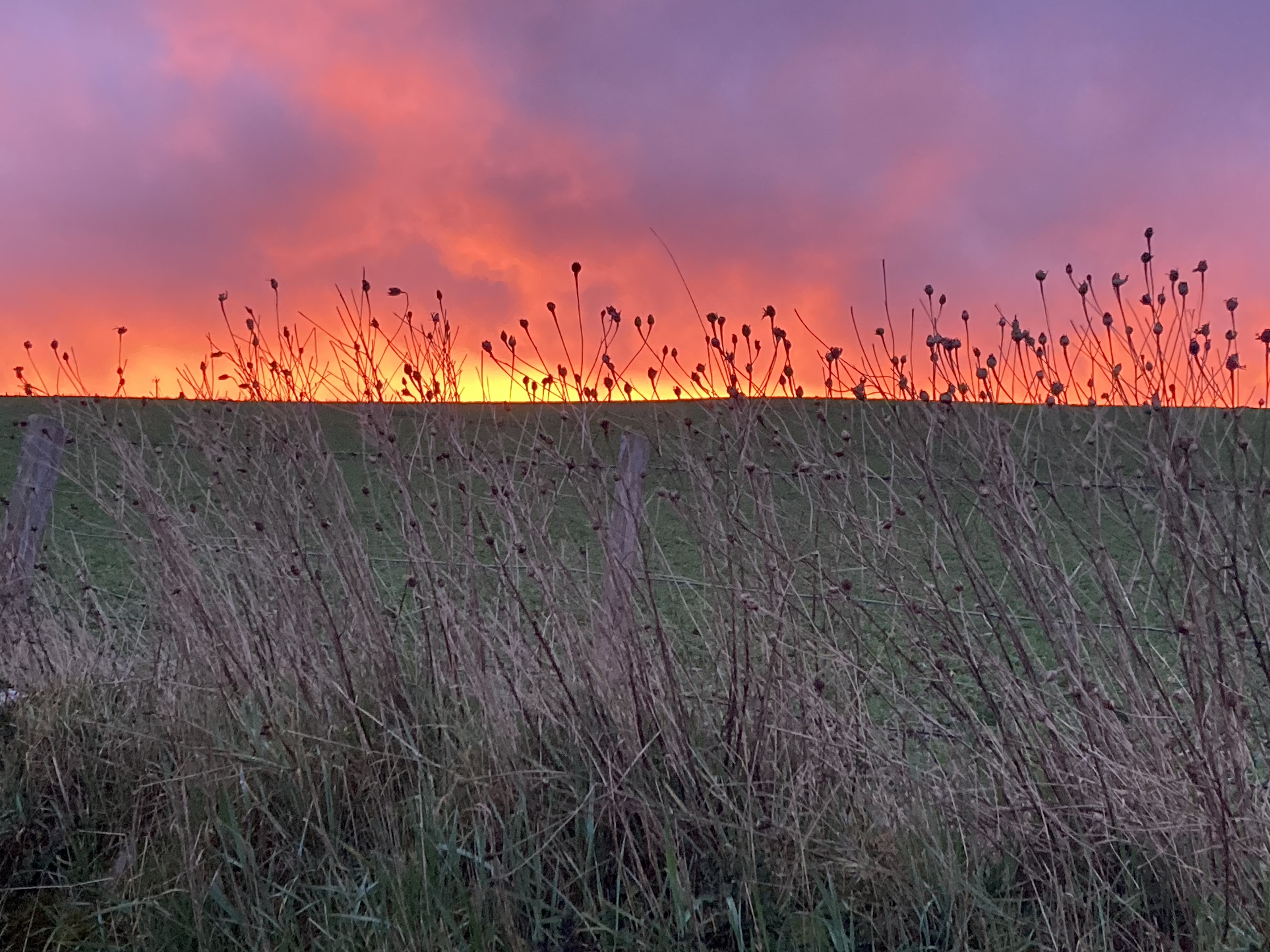
It was an amazing sunrise but to be perfectly honest, there’s not a lot to be said for February this year…..unless you count the ‘d’ words: dark; dank; dreary; dreich; drizzly; I won’t go on, I’m sure you get the picture – you may have actually been in the picture and suffering alongside me. February seemed to go on forever while we all waited with baited breath for March! There were some highlights – a couple of days when we managed to drag ourselves out to get some fresh air but they were few and far between.
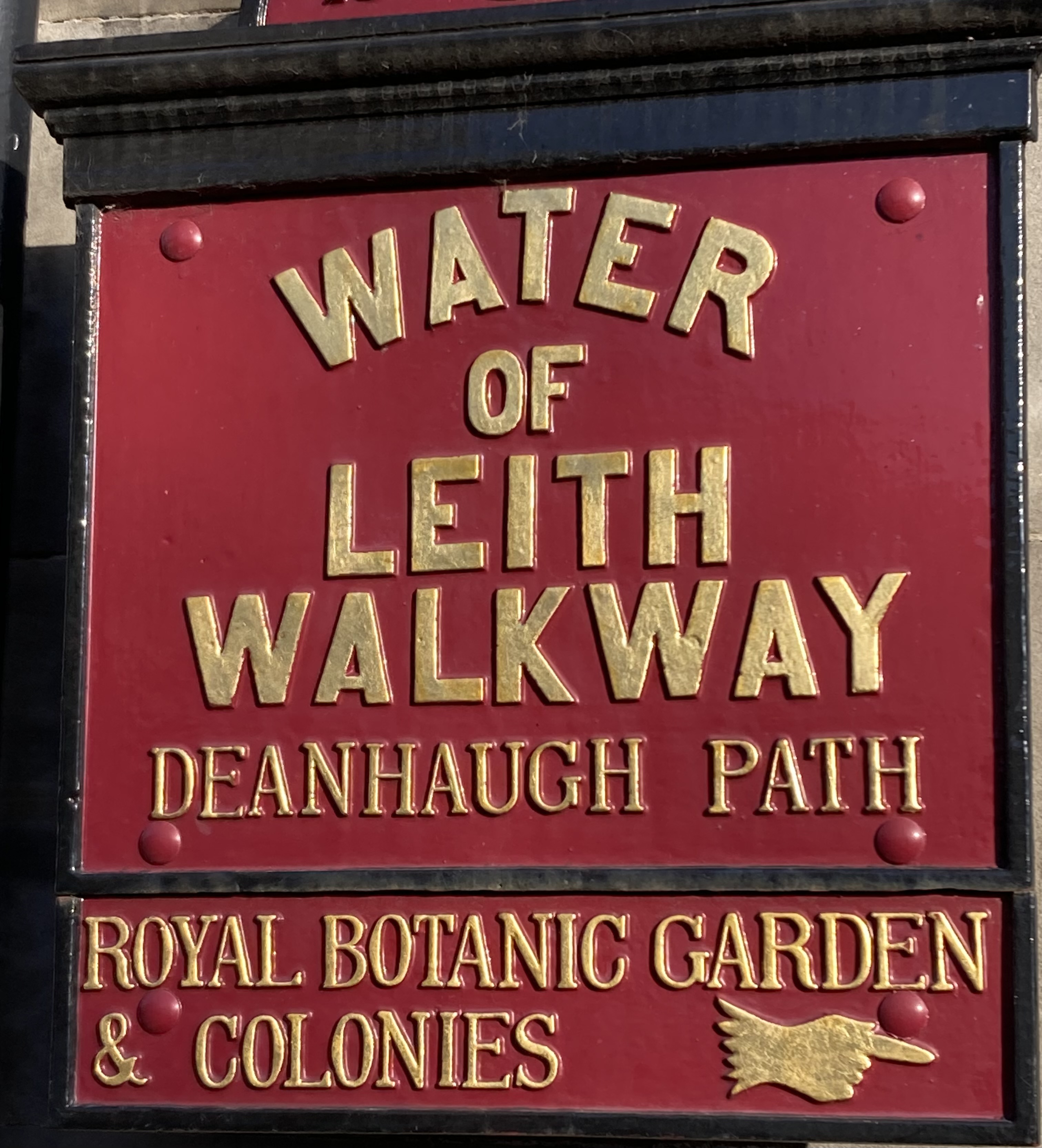
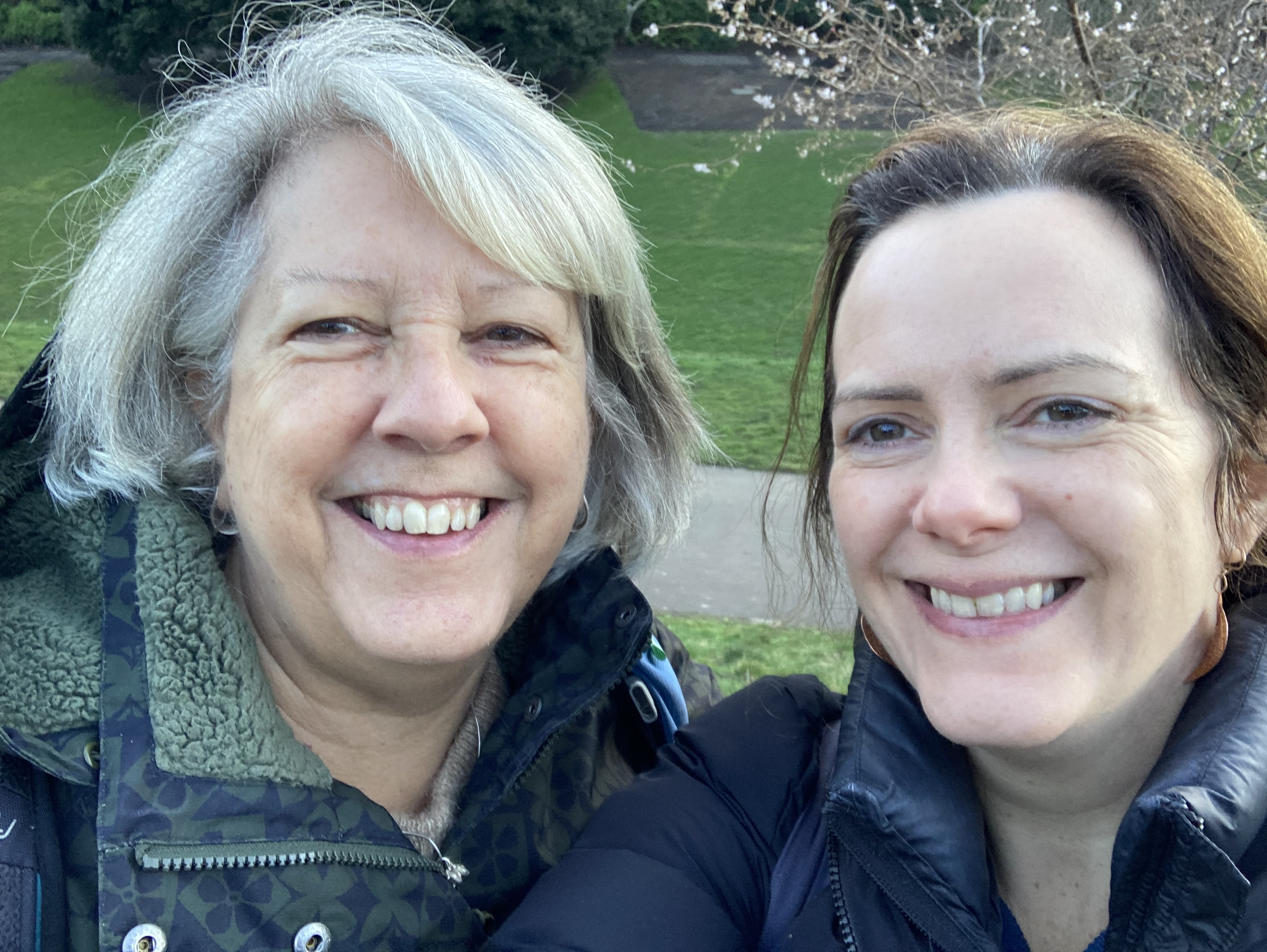
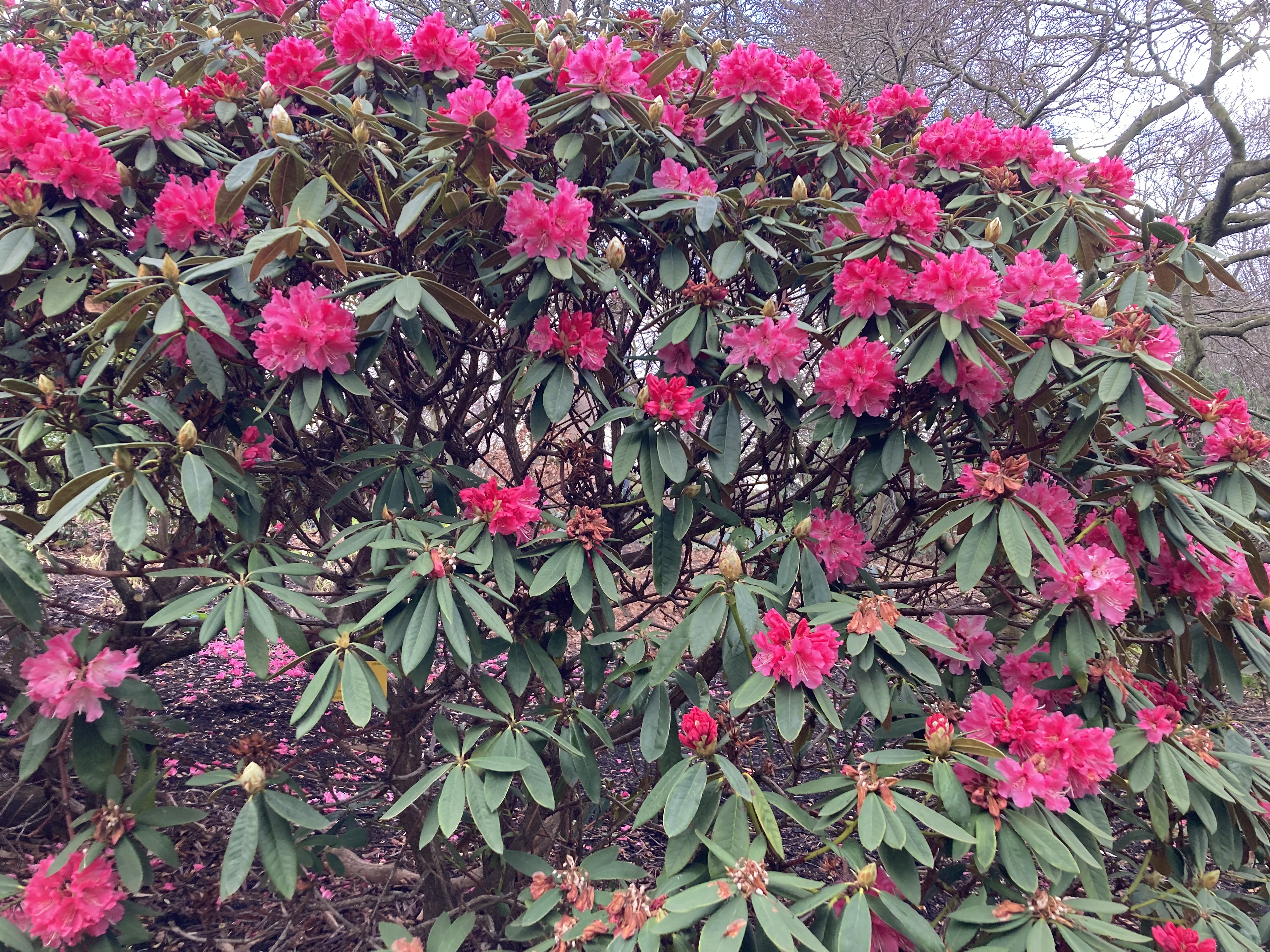
Let’s start on a high note….1st February the sun came out in Edinburgh and Laura and I had a girls day out beginning with a stroll through the sunny Sunday morning crowds in Stockbridge, a visit to the market and a wander through the Botanical Gardens – such a lovely day.
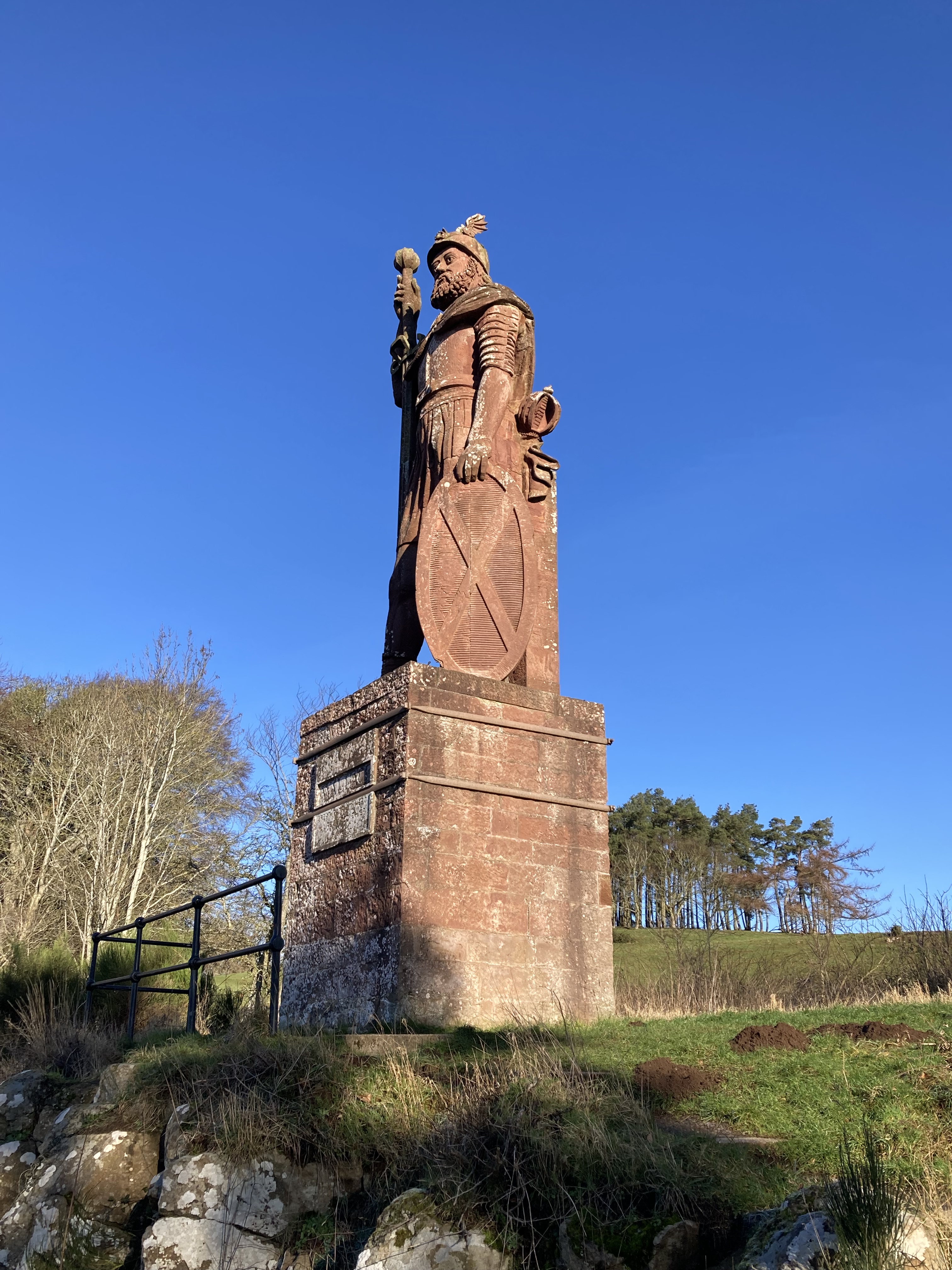
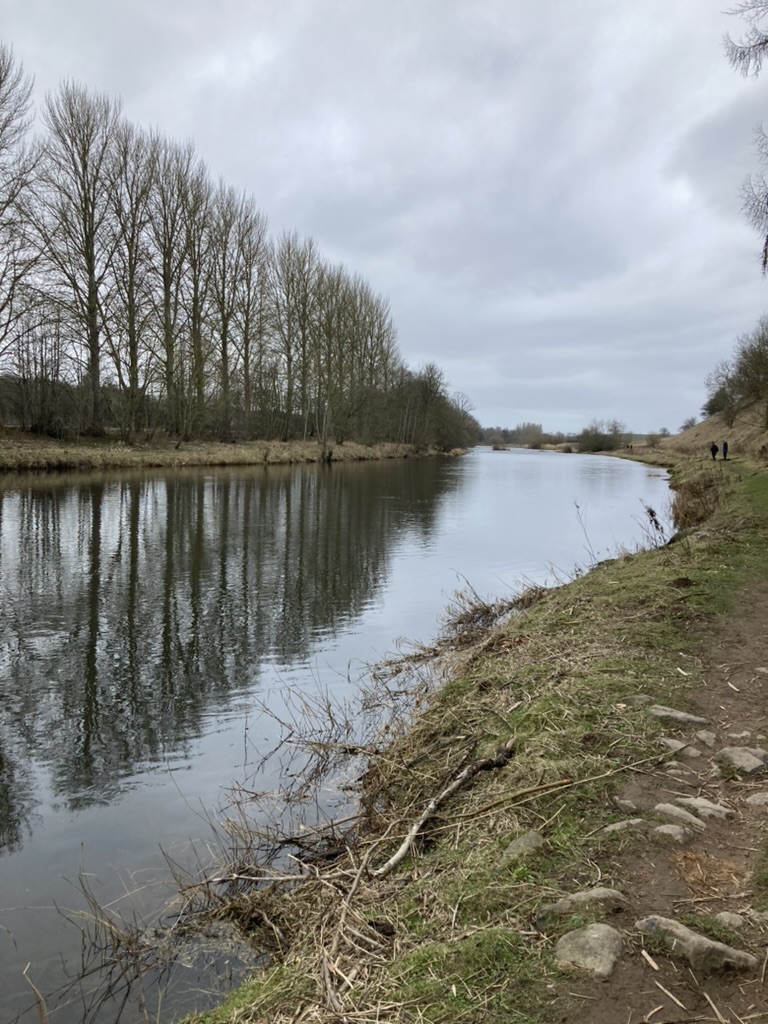
There was another day with sunshine when Mr M and I walked from the William Wallace statue just along the road from Scott’s View, down into Dryburgh and along the river, the sky was blue although there was ice on the ground. The good thing about ice is that it freezes the mud!
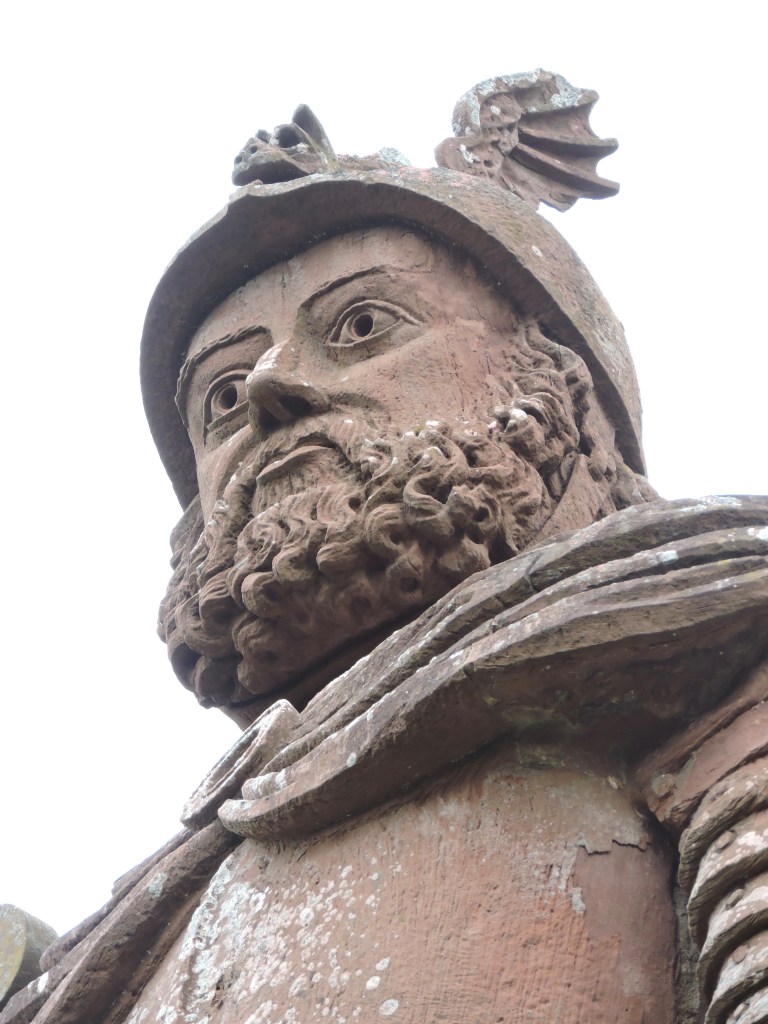
William is impressive – but look at that sky!
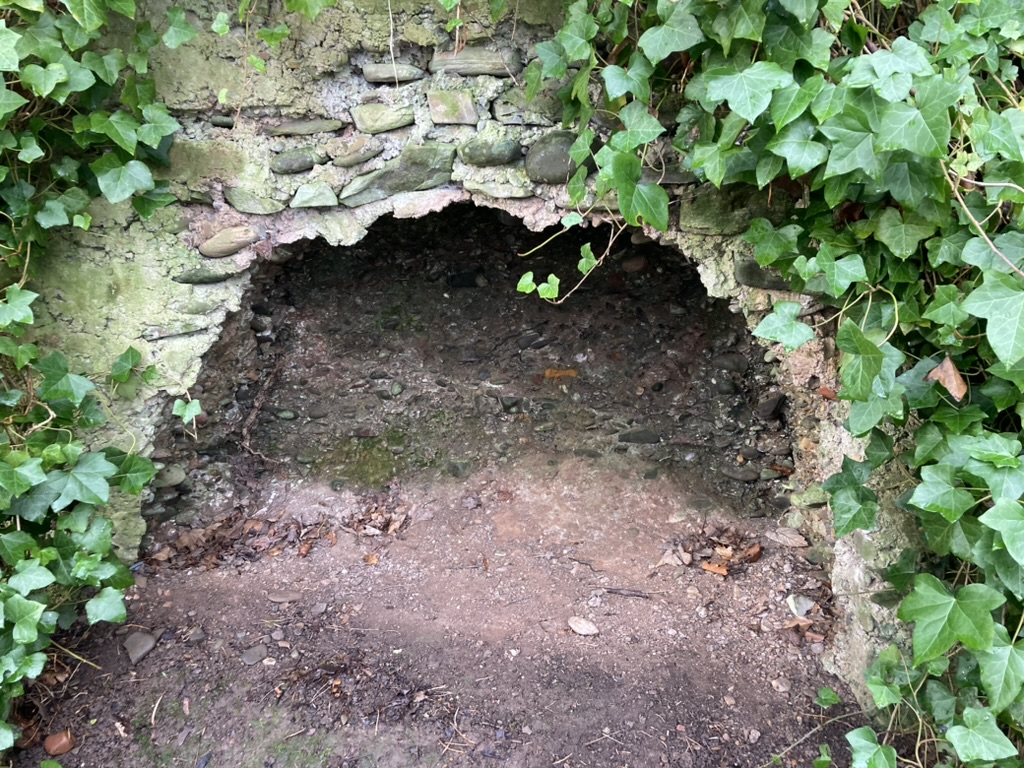
We also walked around St Boswell’s on a familiar route in thick slippy mud – an exhausting walk on this occasion luckily ending at the Mainstreet Trading Co – for lunch and book buying. Have a look at that arch in the photo below…. there are lots of them along the river bank – anyone know what it’s for?
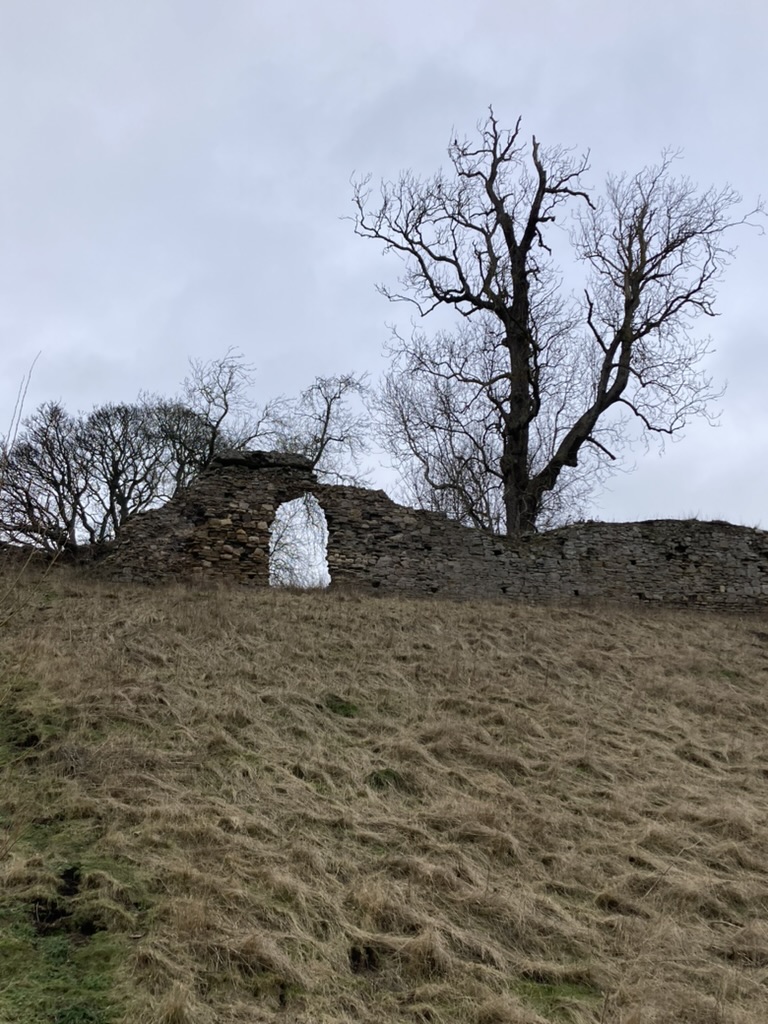
Mr M and I also managed a few miles along the Teviot past the ruins of Roxborough Castle just outside of Kelso
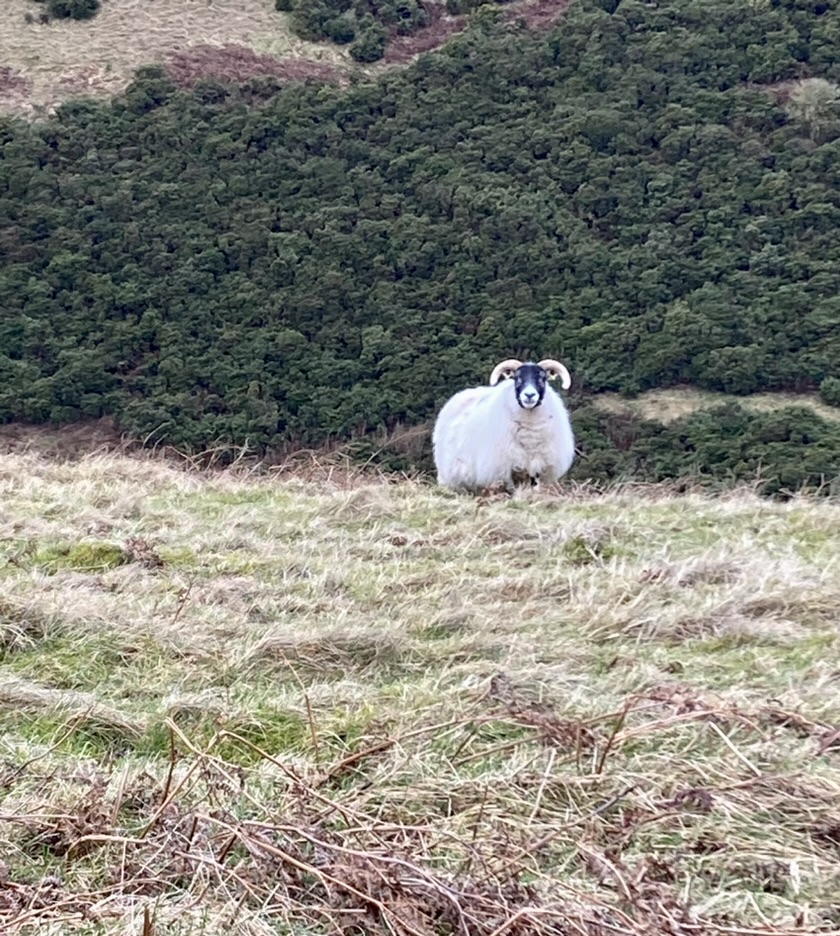
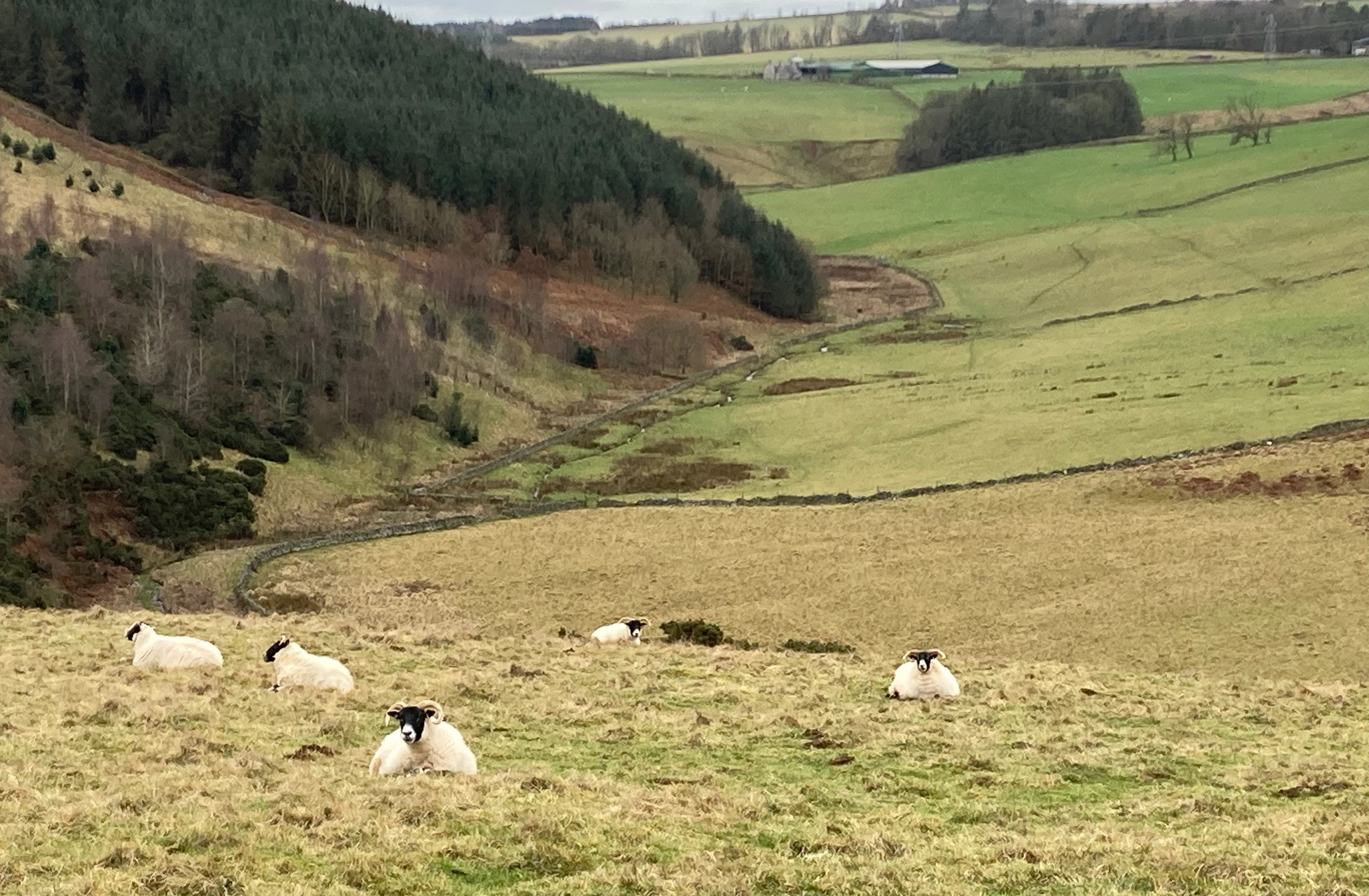
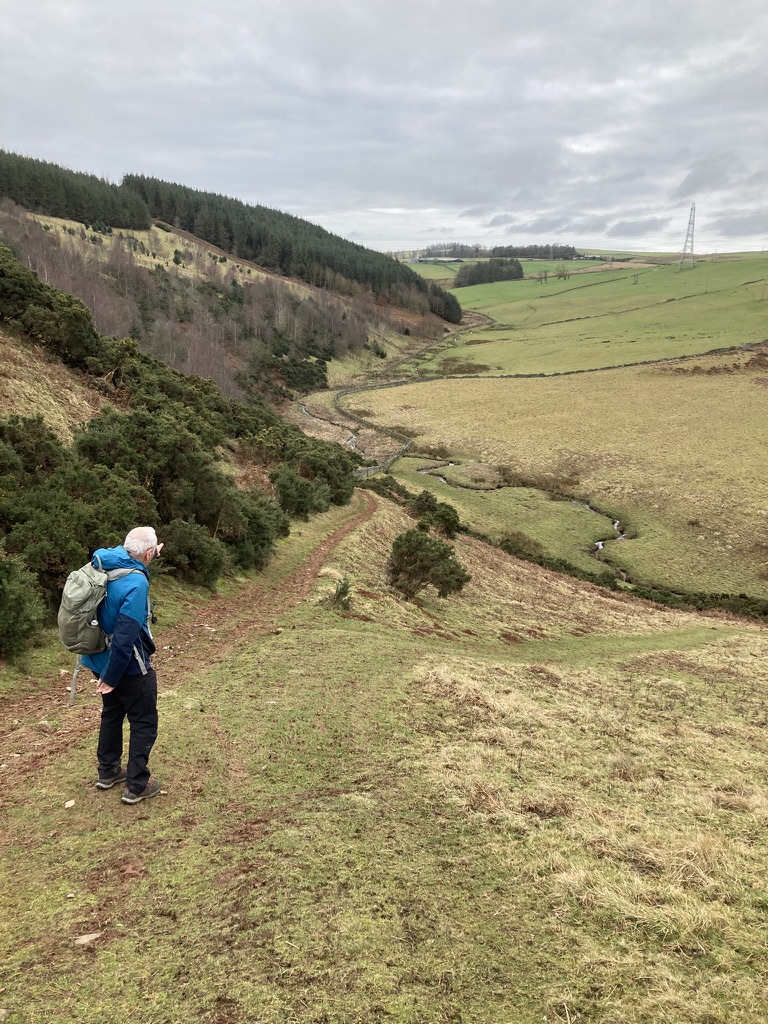
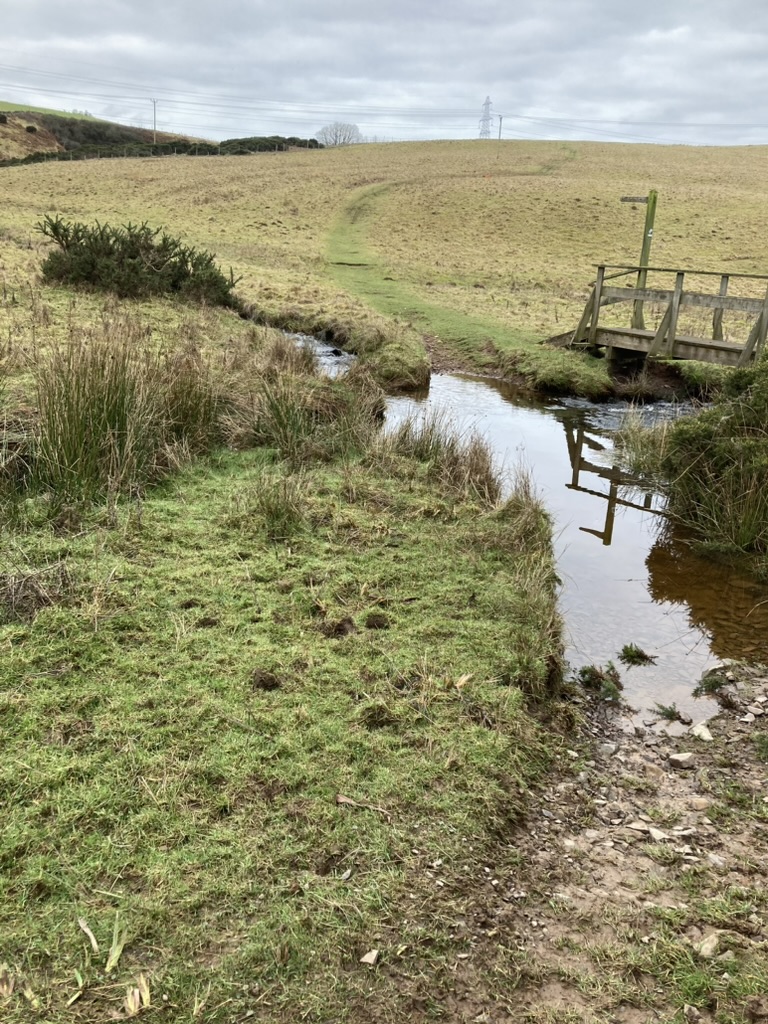
And finally a few days ago a lovely walk following the Southern Upland Way out of Lauder over the moors and then down into the valley and up the very steep opposite side to Cuckoo Wood. We stopped to watch Roy the Sheep Dog rounding up the hill sheep and move them to dryer ground before heading back into Lauder for lunch at the Flat Cat Gallery – you can’t beat a good cafe at the end of a walk!
So….March is here! Spring is in the air – the crocus are flowering, the first daffodils are here and soon there will be blossom on the trees. Time to get gardening! And walking of course……..
“Our fate flows with that of rivers, and always has”
Have you read this book? Is a River Alive? by Robert Macfarlane. I’ve just finished it. It took me a while and I’m a fast reader. It took me a while because it’s so beautifully written, so full of thought provoking narrative and ideas and reminders and comment that I had to keep going back and reading passages again and again. And I had to keep stopping to give myself time to think about all that was written there about rivers and nature and our relationship with those – individually, historically, politically and culturally.
Robert Macfarlane has written an extraordinary book about the concept of the river as a living, flowing, life-giving and life-affirming being who should be recognized in law to have rights. He follows the course of three rivers – in Equador, India and Canada – examining and explaining how rivers are alive and how and why they die and crucially how they can heal themselves given the opportunity:
“Rivers are easily wounded. But given a chance, they heal themselves with remarkable speed. Their life pours back”
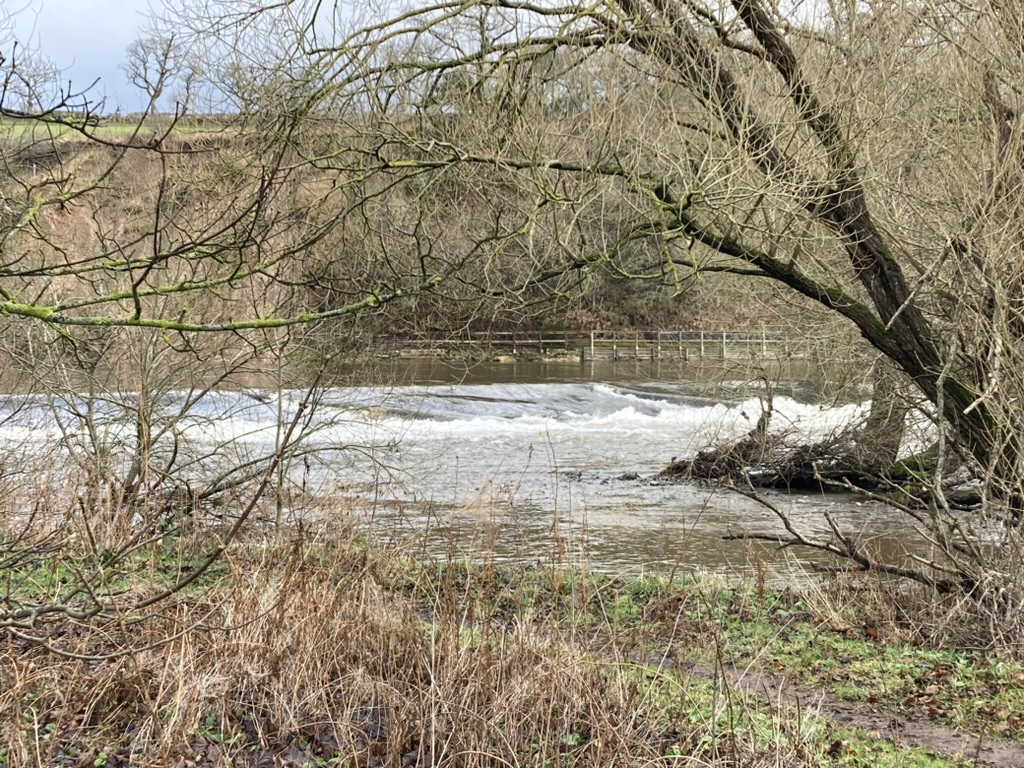
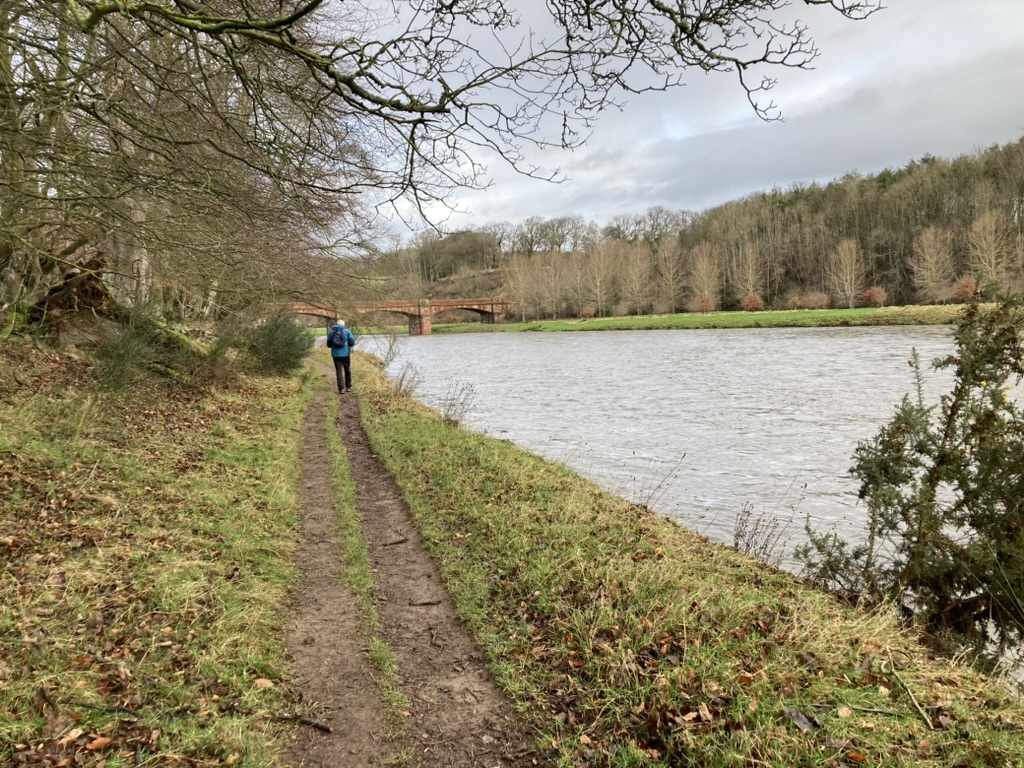
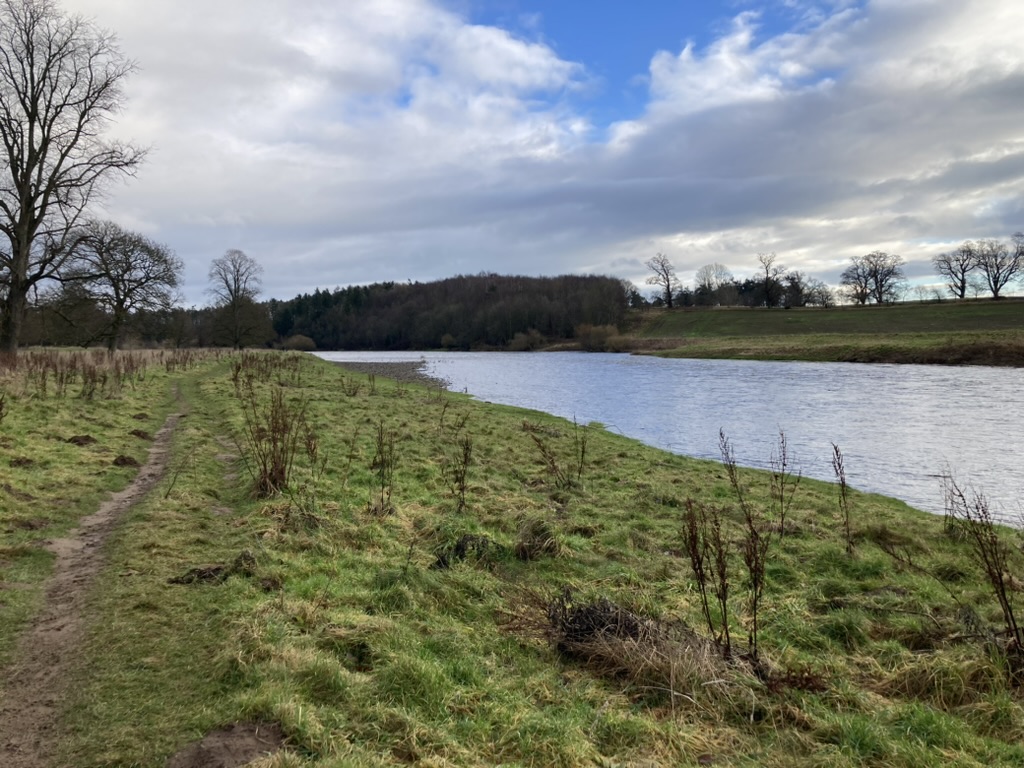
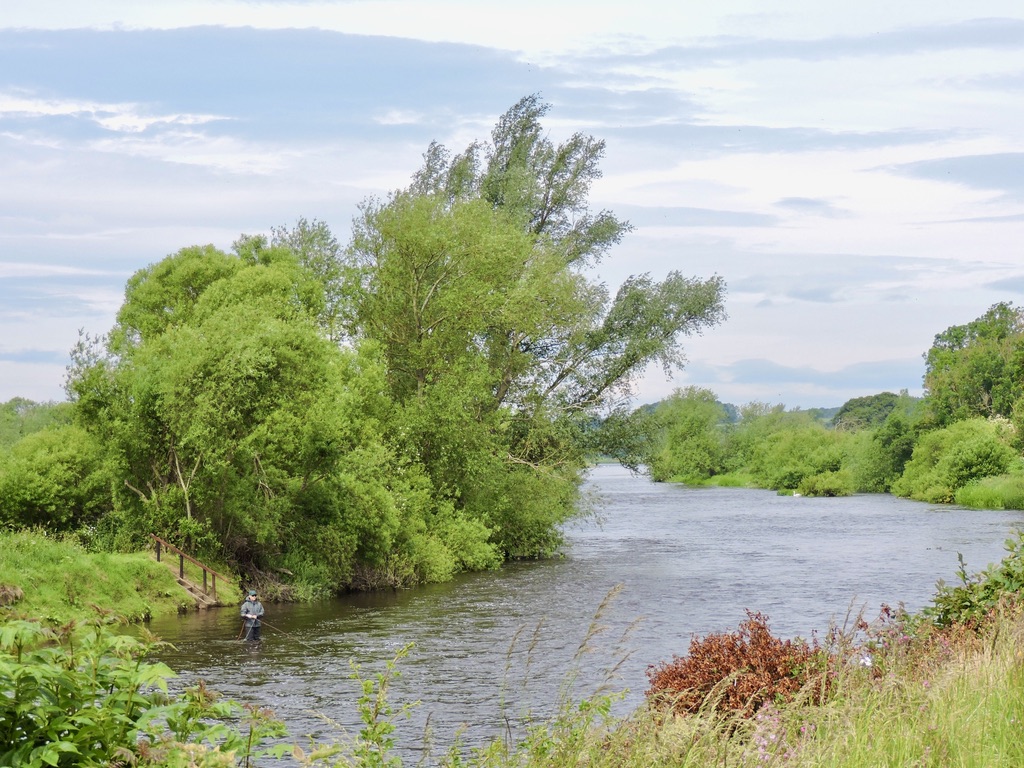
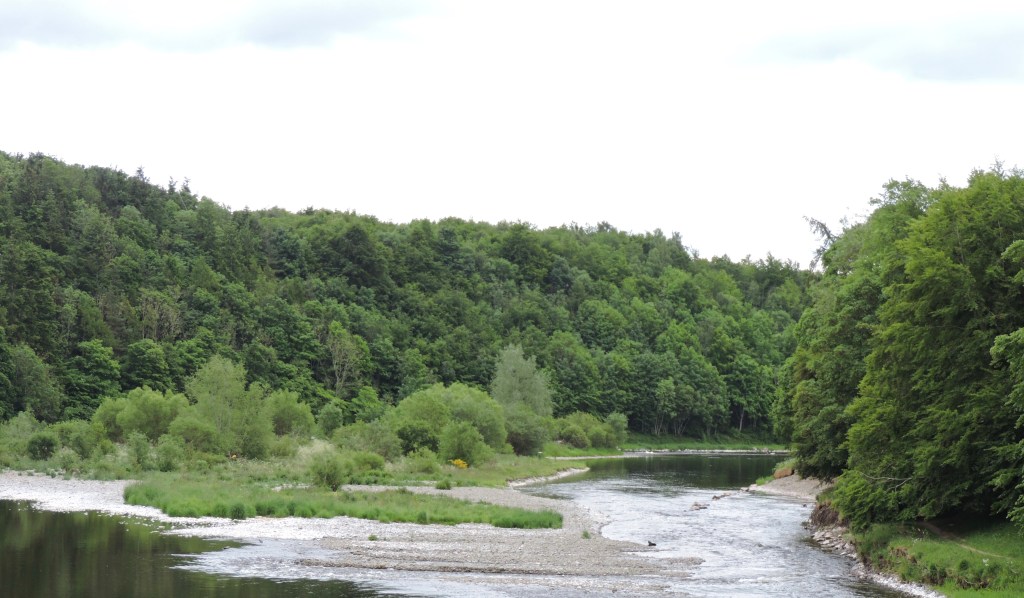
As we walked along the River Tweed on this walk, the book was on my mind. Not that I think the Tweed is an example of a dying river, less so anyway possibly than many other rivers in Scotland. Indeed the Tweed may be one of the lucky ones – the Tweed Forum (https://tweedforum.org/who-we-are/about-us/ ) having been working to conserve, enhance and restore the Tweed and its catchment area for around 30 years. It’s just that when you read this book, and then you walk beside a river you can’t help wondering how different the scene might have been before we polluted, drained, damned and altered the course to suit our own needs without thought for the needs and rights of the river.
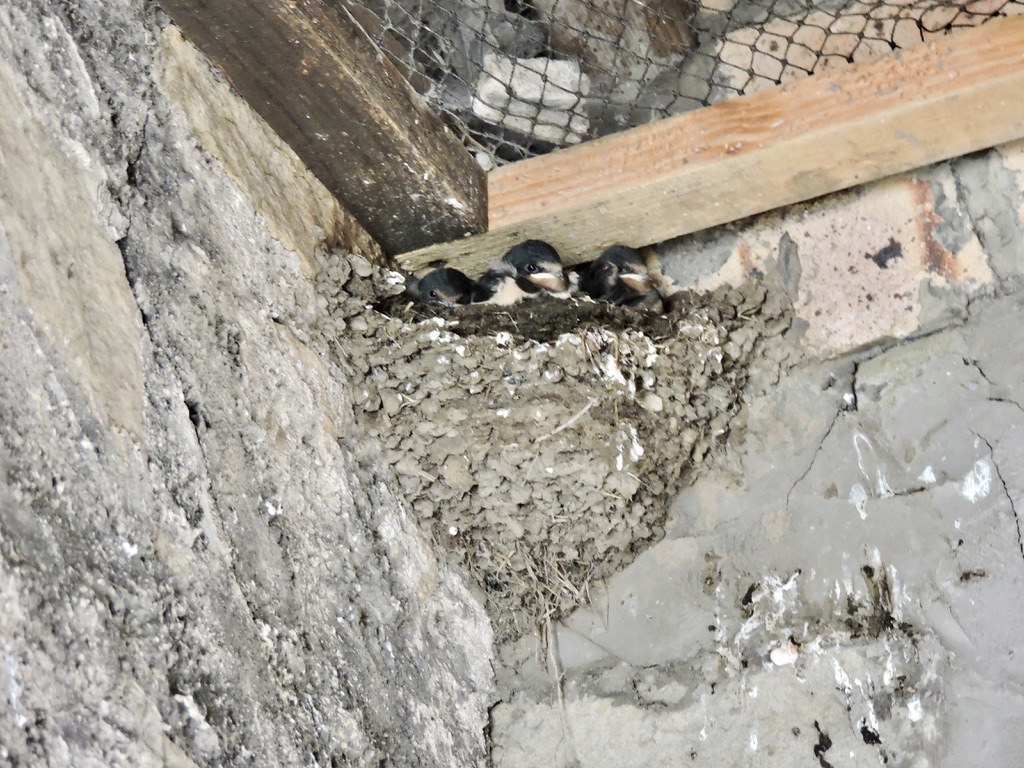
We began walking at The Hirsel (The Hirsel Country Park) where we spotted a swallows nest high up under an archway – 3 tiny baby swallows peering down at us. We walked around the lake and through the woods and rhododendron bushes to emerge on the main road which we crossed to enter the hamlet of Fireburnmill and head downhill to the river which/who (read the book) is high after the torrential downpours of the previous weekend.
We should not be fooled by this full and fast flowing river into thinking water is plentiful in Scotland. We are currently in a state of water scarcity – not as rare an event as you might think! (https://beta.sepa.scot/water-scarcity/)
On the opposite bank – in England in fact! – there’s a Gillie’s boat tied up. The Gillies know the river well, understand the conditions and support fishermen to find good spots for salmon fishing on the Tweed (and other rivers). If you’re interested in the life of the salmon and how Scotland needs the salmon, there’s an amazing film called Riverwoods which I saw locally a couple of years ago telling the compelling story of this fish that once lived in the forest. And how “Scotland’s Atlantic salmon – the King of Fish – is not only the ultimate angler’s prize, but a key building block in a complex forest ecosystem” https://www.riverwoods.org.uk/streams/thefilm/. I don’t know if you can still watch it anywhere but well worth a try.
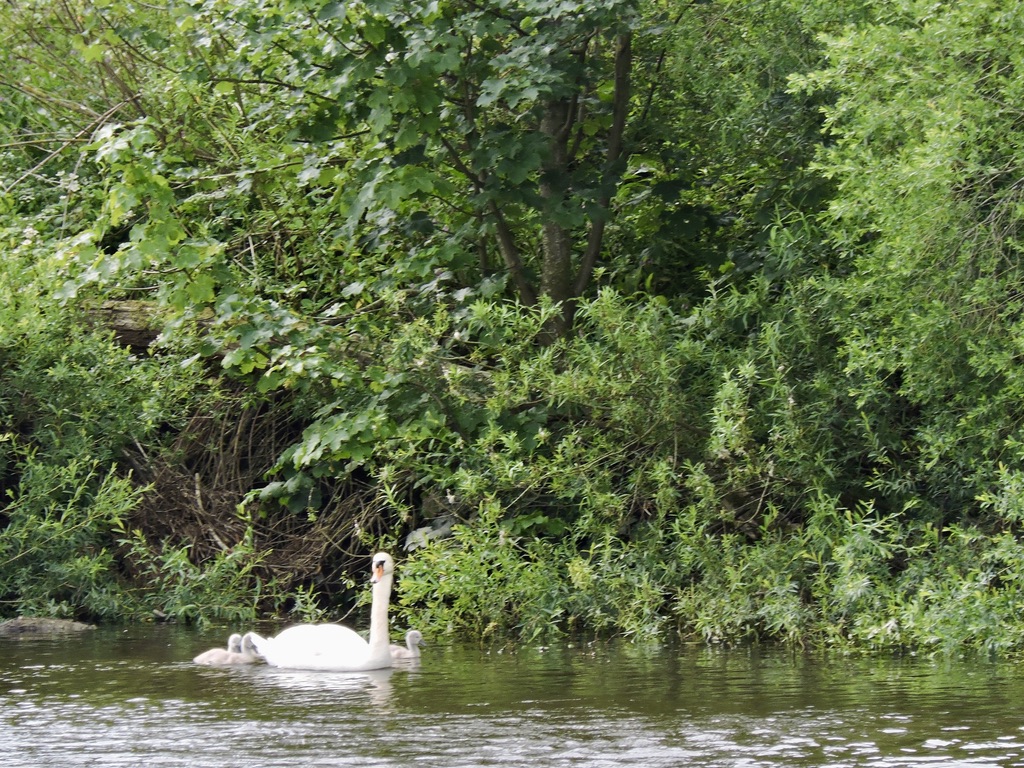
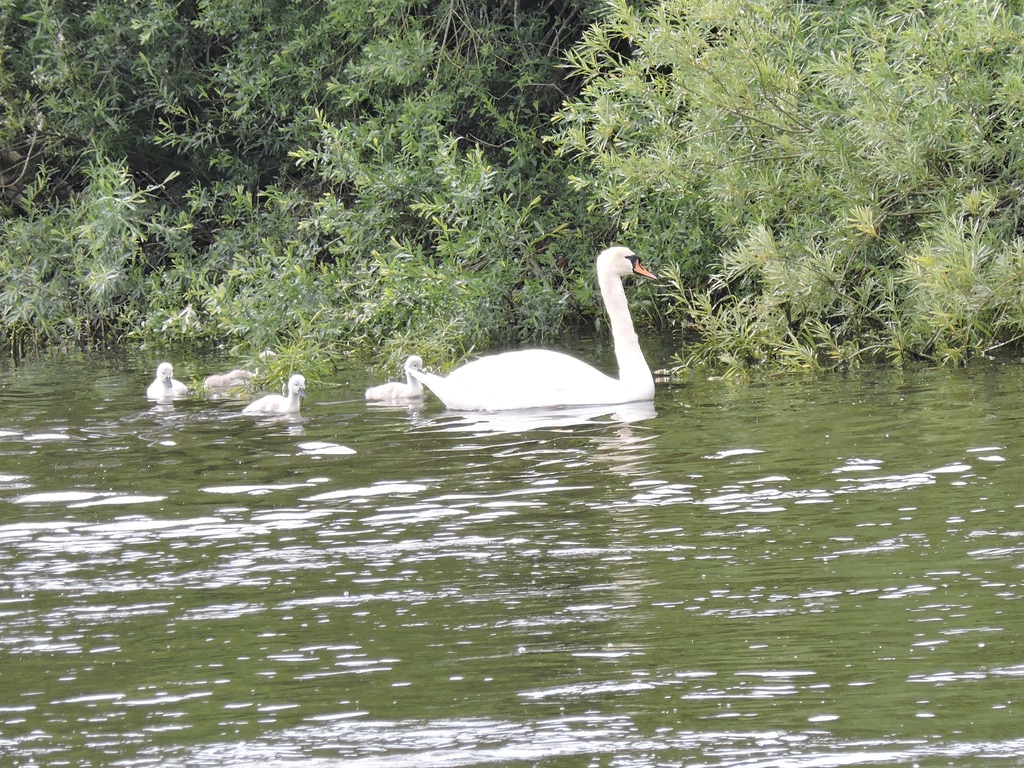
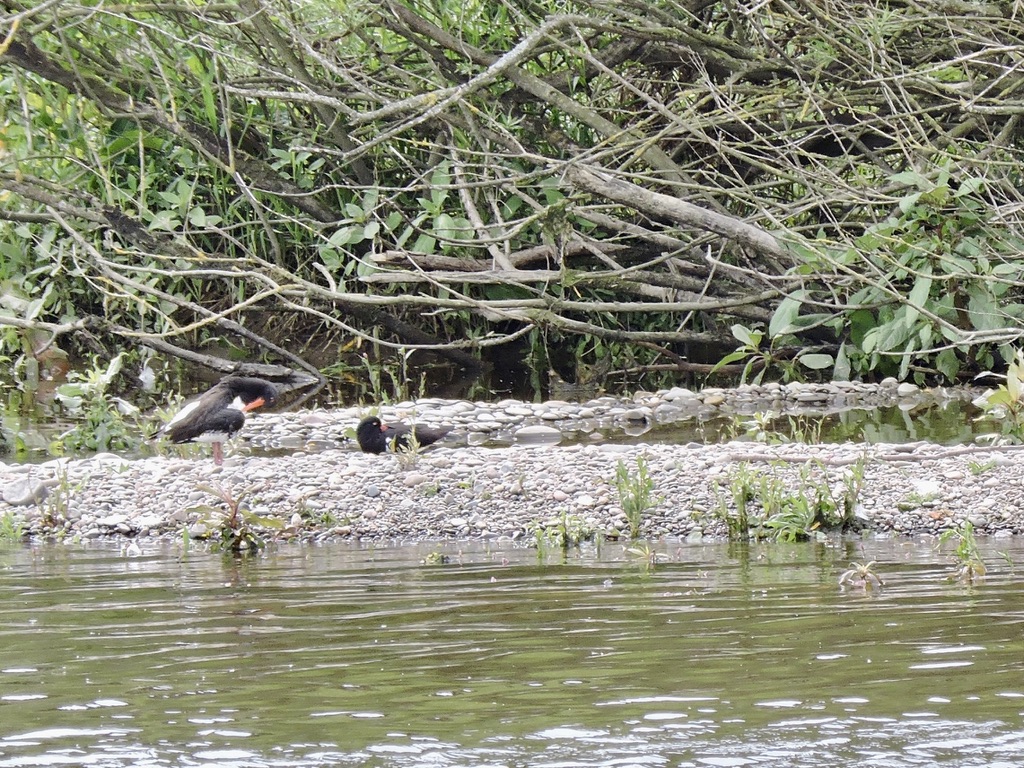
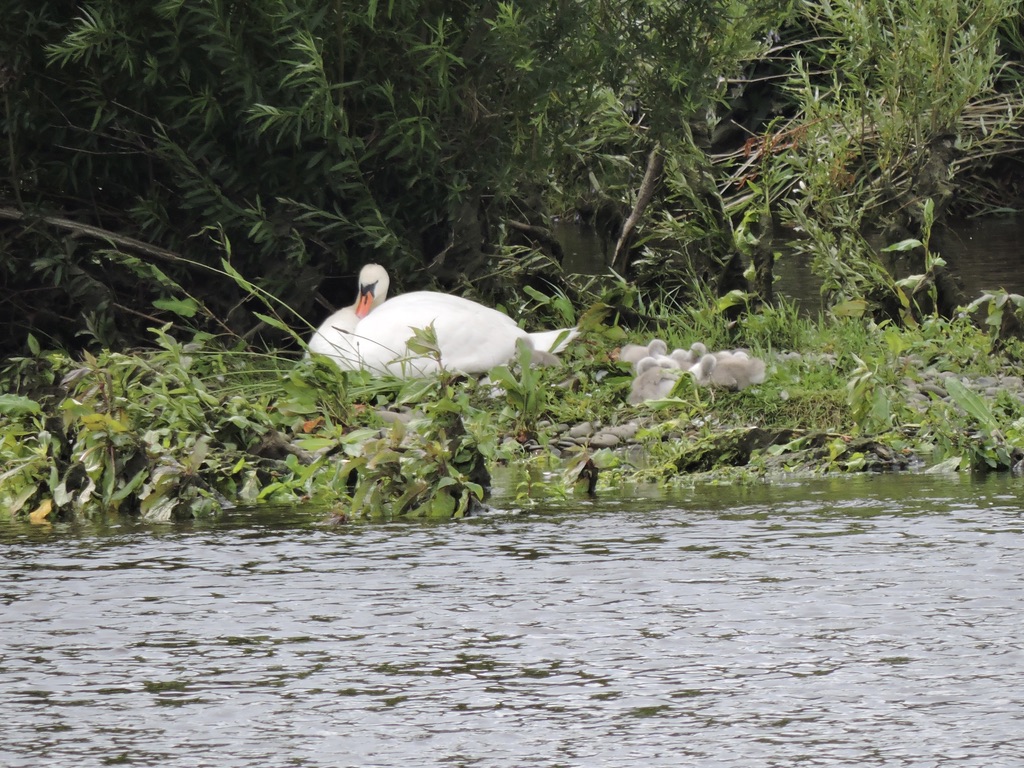
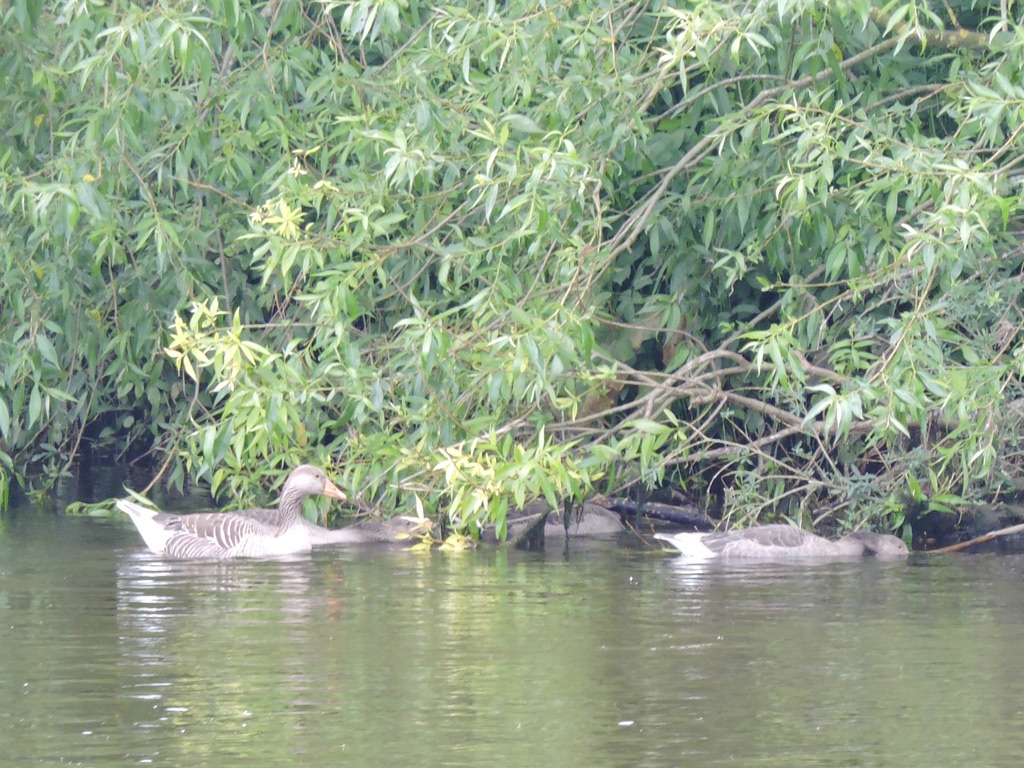
We see plenty of evidence of life on this river as we wander along, a pair of egrets, heron, oyster catchers, swans and cygnets, ducks and greylag geese. I remind myself that this river is only at the beginning of a journey to hopefully return to a state of wellbeing, their life pouring back. “Hope is the thing with rivers.” (Macfarlane 2025)
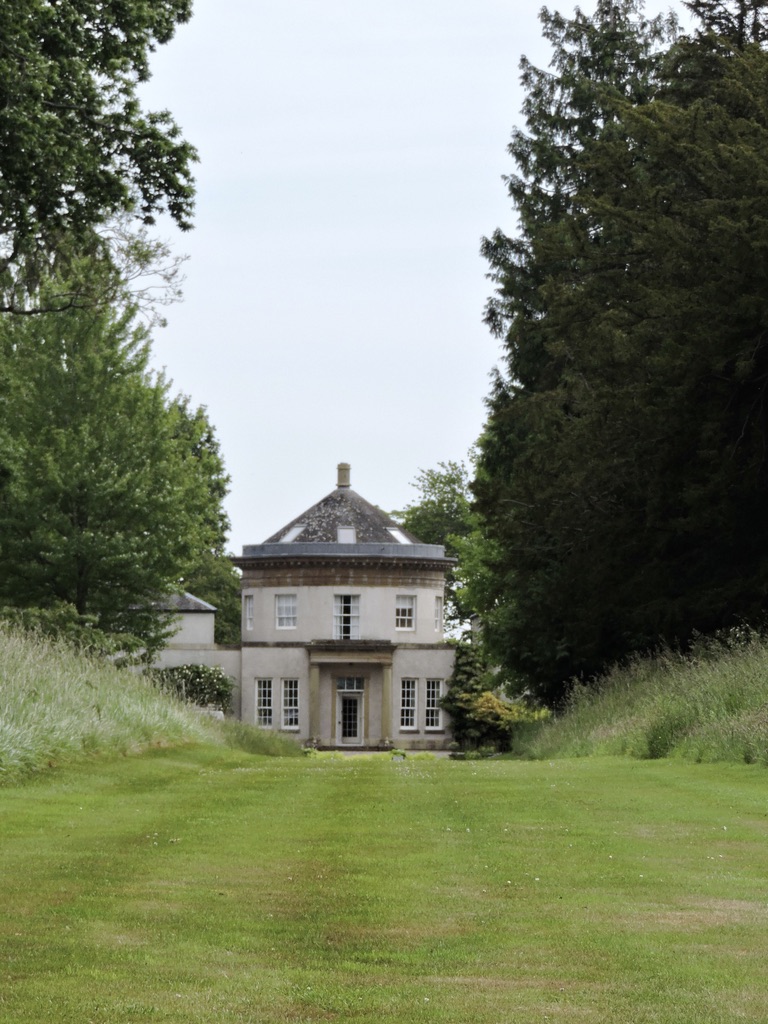
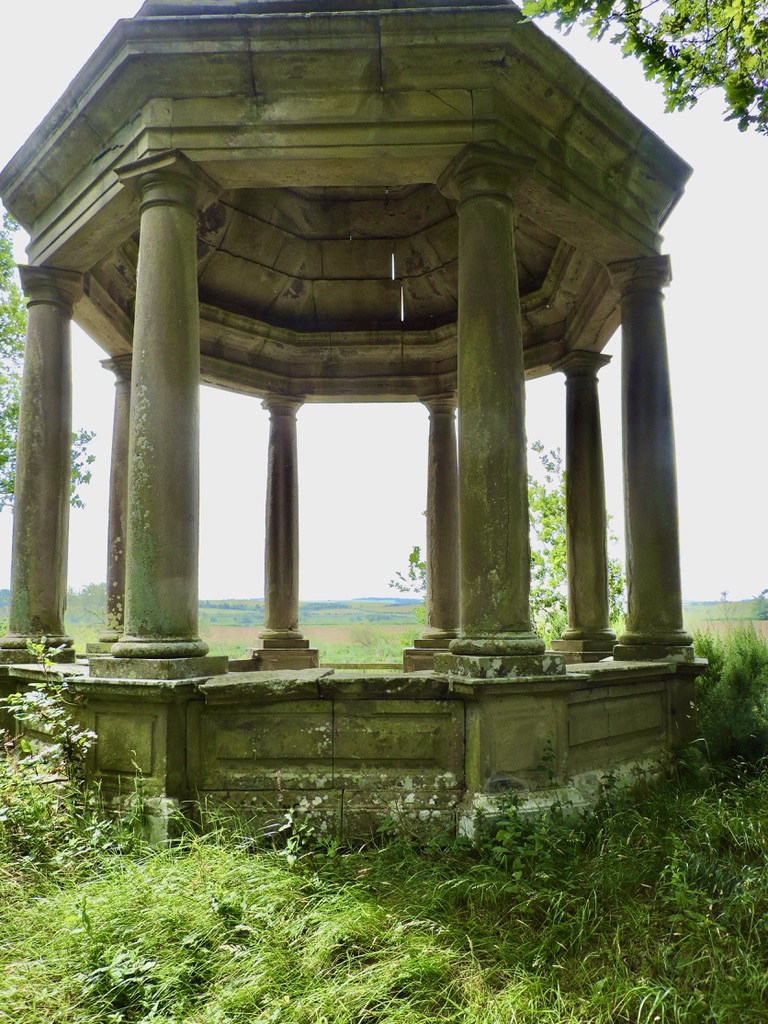
Eventually, after a mile or more we arrive at the Lees Estate with it’s roundhouse and temple. Originally recorded in 1576 the estate was acquired by the third son of the first Earl of Haddington who “by his riotous living, he dilapidated all, not only the lands but also great sums of money besides”. I have to wonder what damage the river, running innocently across his land, suffered from because of his lifestyle. The original house was replaced by the roundhouse in around 1976 and the Temple was built around the 1760s as an ornament in the garden overlooking the river, the stretch of river here becoming known to fishermen as Temple Pool.
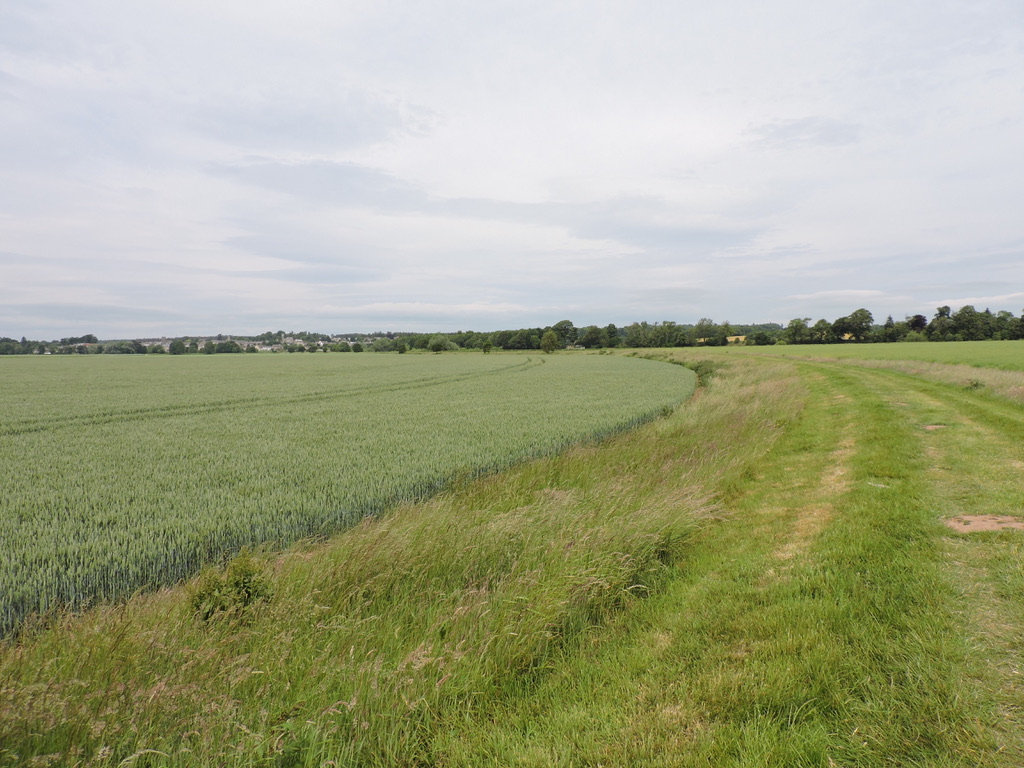
As we skirt the garden of the estate and emerge through woodland back onto farmland we follow the river around a huge ox-bow by walking along a raised bank.
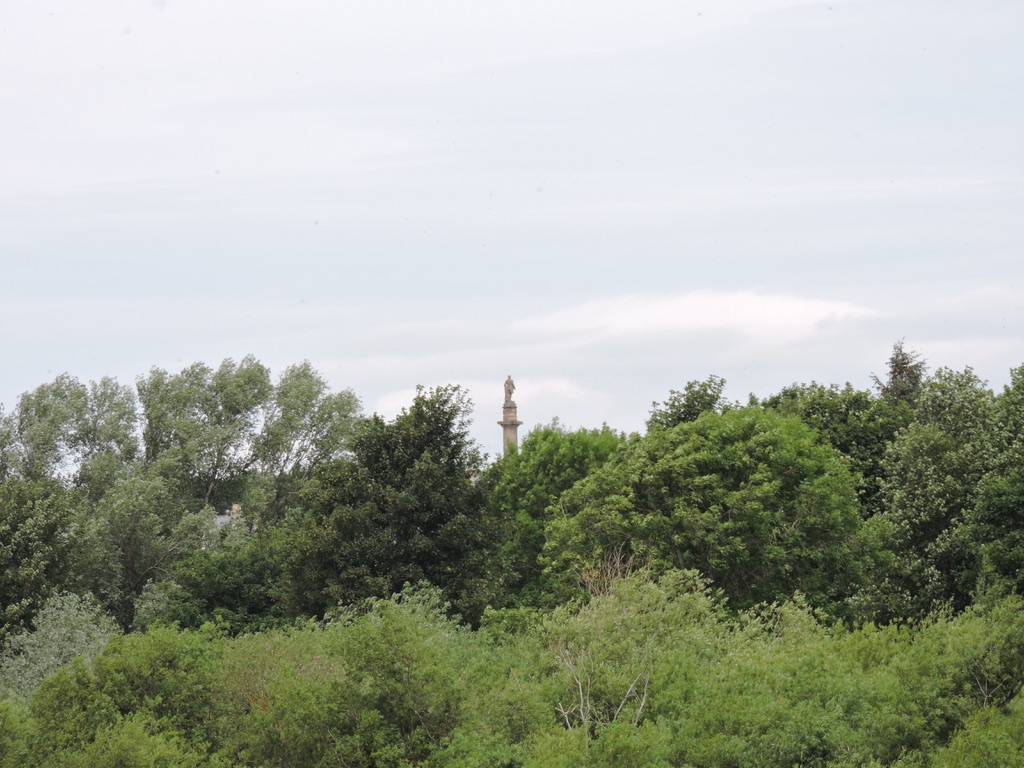
Fields of wheat and peas sit within the ox-bow and in the distance we can see the tall column dedicated to Charles Marjoribanks a liberal MP in 1832.
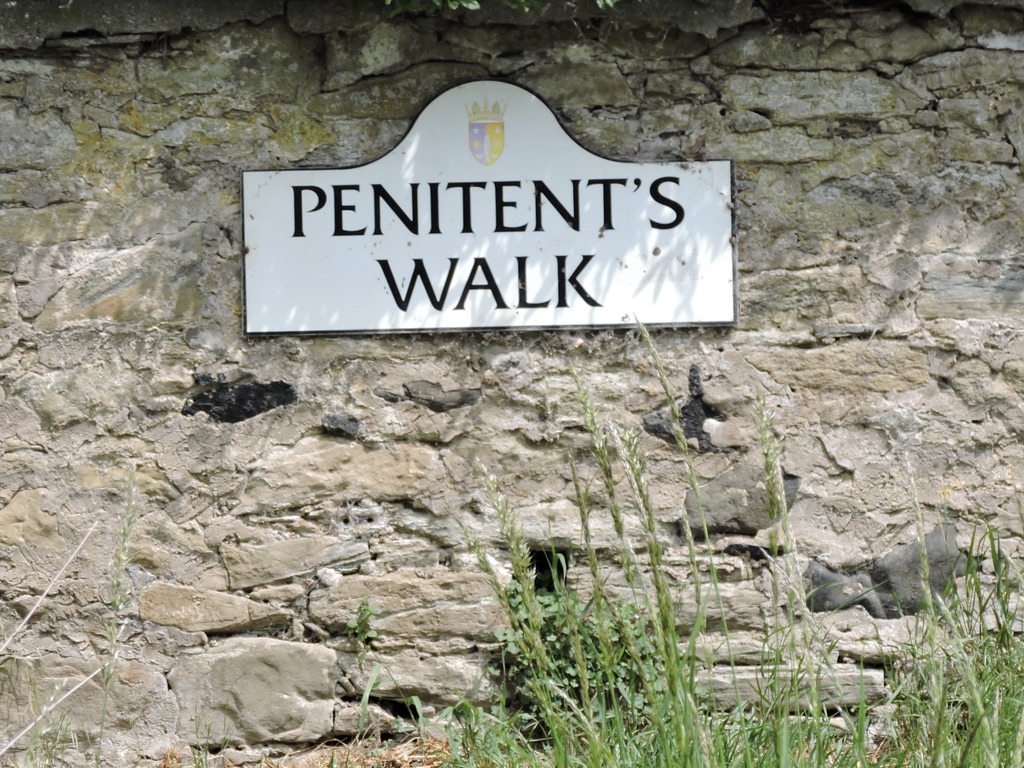
We cross a little wooden bridge over a burn and are back in Coldstream opposite the former Cistercian nunnery. The road to our right is Penitents Walk – the nuns are said to have carried the dead and injured from the Battle of Flodden along this way.
Then we just have to walk up the main road and along the very long straight driveway to return to The Hirsel.
“There are few things as powerful as an idea whose time has come. Over the past twenty years, energized by ecological emergency, the young Rights of Nature movement has repeatedly inspired new forms of future dreaming, and unsettled long-held orthodoxies by appealing to imagination as much as to law.”…………………..
“Rivers, above all, have become the focus for this movement.“
“Even when the world around us is a dark place, the birds still sing, they still migrate – they’re just being there, being, in a way that perhaps we all aspire to be ourselves”
Bird Therapy by Joe Harkness
This week is a strange one. It’s annual leave for me, that means I get to take time off from my paid jobs – which I love – to stay home and do my unpaid ones – about which I’m slightly on the negative side of ambivalent. Luckily, the young Ms RR remains in residence and came up with the idea that I should go out! Another strange thing – going out….. We are of course, in Scotland, in Phase 1 of ‘returning to normal’ which means that unless you’re shielding, you can go out within about 5 miles (or not so far that you need to use a toilet in another persons house). Of course going out, when you’re a carer usually involves a lot more than just…..well, going. However, I currently have live-in help in the form of Ms RR, so after considering all of the reasons why I shouldn’t go and failing to come up with a logical one, I went. Alone. On my own. Yet another strange thing.
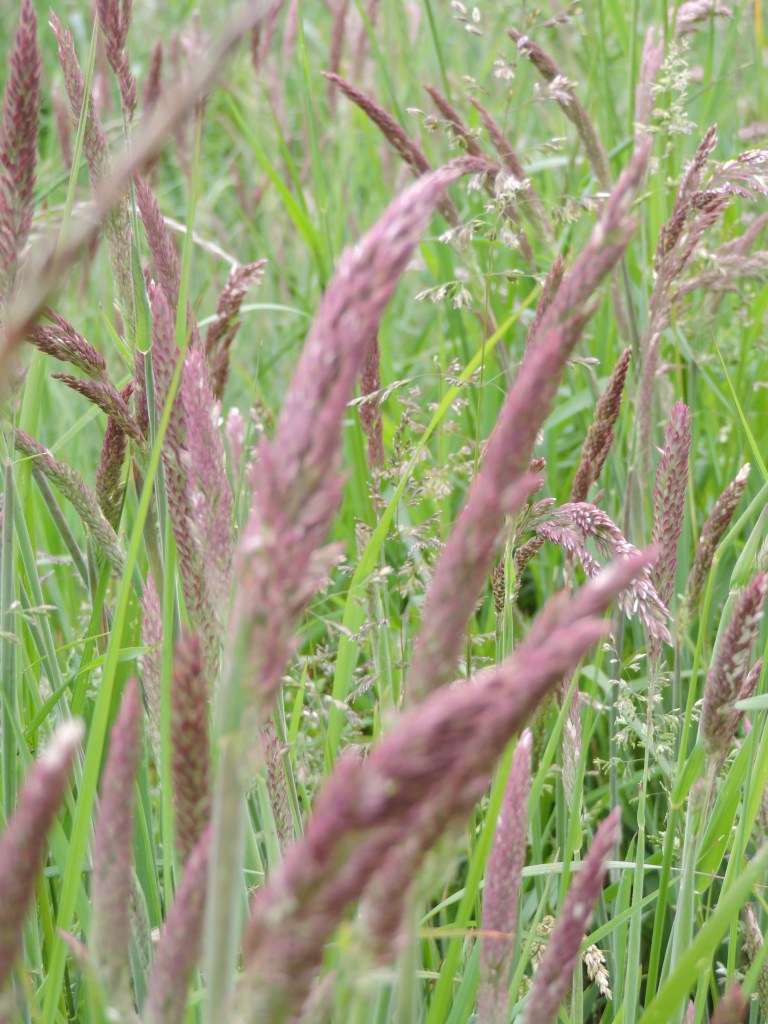
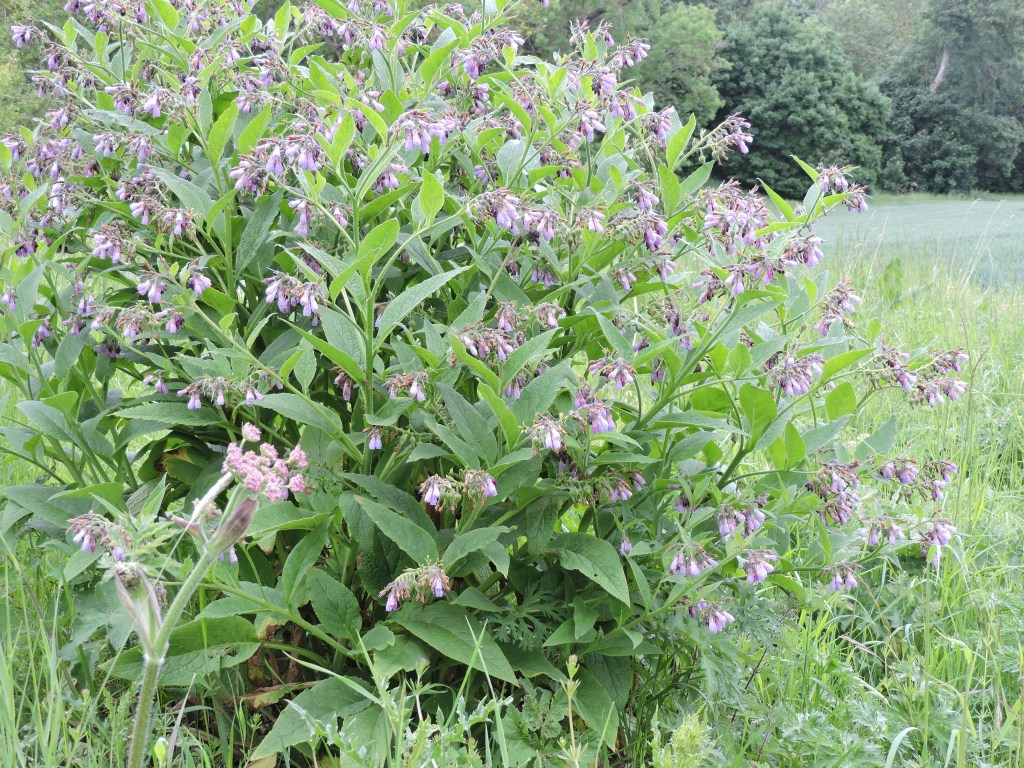
So, there I was, out, alone. With my walking boots, my book, a flask of tea, a chicken sandwich and a vague sort of plan to walk along the River Tweed from Dryburgh. At the weekend we had a picnic lunch on the banks of the Tweed and then walked a little way along through the meadow grasses – they were stunning, those pink tinted grasses interspersed with white umbellifers and surrounded by beautiful clumps of Russian Comfrey. I decided then that I wanted to come back and here was the perfect opportunity.
Russian Comfrey
I stopped on the way at Scott’s View, just because it is such an amazing view.
The view from Scott’s View
And that’s when it happened! The first thought – that this was silly, that this was a bad idea, that I couldn’t walk along the river bank alone, sit and have lunch alone. Now, for those that know me, this isn’t such a surprising thing – there are lots of reasons why I shouldn’t do this thing on my own, not least of which is that I have a well known propensity for falling down! I’m always falling over, I’ve lost count of the times I’ve arrived home bruised and scratched from taking a tumble into thorny bushes, or down a flight of muddy steps. What if I fell into the river! Or, heavens above landed in a bush and couldn’t get up! Even worse – what if someone saw me!! As well as this possible calamity, there was the ongoing problem of the foot pain, some days a mile is all I can manage without the burning incapacitation of pain in my feet. What if I got to the river and then couldn’t walk back! Also, though I used to walk a lot on my own, when we lived in Cornwall…..things have changed since we moved North and I seem to have had my ability to venture out on foot alone eroded. All this thinking flew through my brain in nanoseconds as I contemplated the view and listened to Alexander Armstrong on Classic FM. What could I do?
In the end, what I did was, start the engine and drive a little further on. I thought that if I got to Dryburgh and strolled just a few yards to the river, that would be enough. I could eat lunch in the company of the ducks and then stroll back again. So it was with some surprise that I found myself pulling into the car park for the viewpoint from the Wallace Statue – a fair walk from Dryburgh – and steeply downhill at that. But here I was. No-one else in the car park, so safe to leave unnoticed, if I changed my mind.
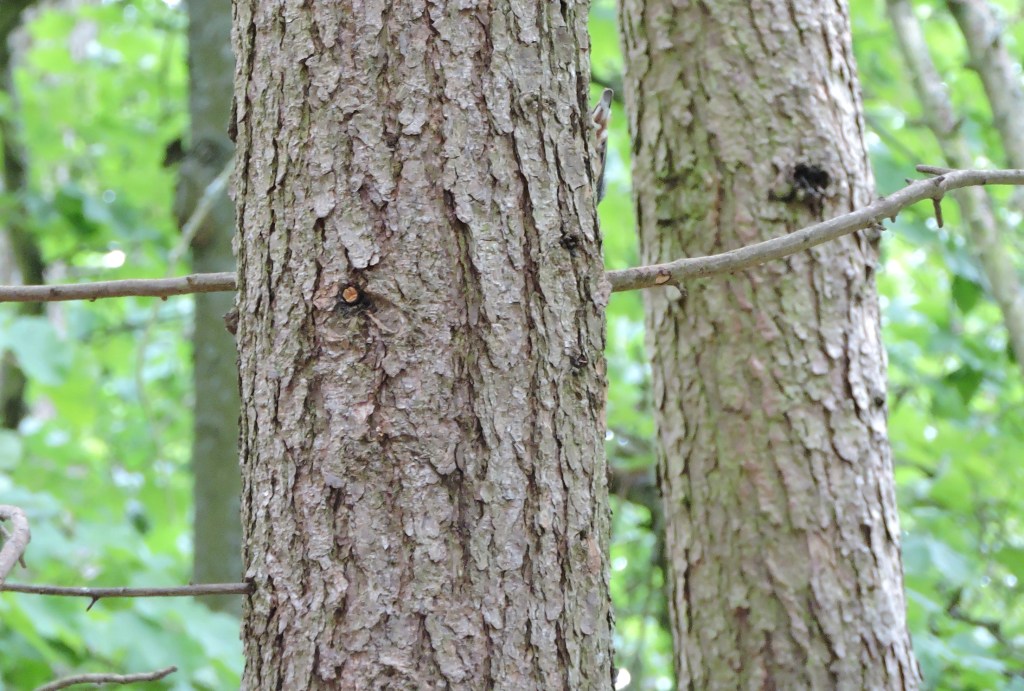
And so it was with some trepidation and a few palpitations that I stepped out of the car, changed into my walking boots and hoisted my backpack onto my shoulders – you’re not a real walker unless you’re carrying a backpack! Off I set, into the woods…..all the while I was telling myself that I only needed to get to the first bench, sit with my cup of tea and then drive on to the next viewpoint. And then…..not 100 steps into the wood, I spied a bird with a long pointed bill working its way in a hopping action up and down a tree trunk! I stood and watched, and I saw another….Tree creepers I thought. Oh how jealous Mr RR was going to be!! I watched them flitting about, every now and then flying off to a further tree and then back again. It occurred to me that they were feeding young, although I could see no nest in the further tree. I stood and watched and tried to catch a photo for many minutes until a sound somewhere nearby sent them skitting away.
Spot the bird!
It wasn’t until today, that I checked the little bit of bird that I’d managed to capture on camera that I realised – not tree creepers at all, the tail is all wrong and these birds were going up and down the tree – tree creepers only go up! The only British birds that go down the tree headfirst are Nuthatches – elusive, and according to the RSPB website, only rarely seen in southern Scotland, they are found in deciduous woodland and nest in natural holes in trees.
Whatever they were, the standing and the watching and the silence had calmed me and I set off determinedly for the river.
“Jon Kabat-Zinn, whose work most modern, mindful stress-reduction therapies are based around, defines mindfulness as ‘paying attention, on purpose, in the present moment, and non-judgementally’. When applied to birdwatching practice there are evident correlations. You pay attention in a particular and focused manner, not just on birds, but also on the wider environment. It’s very much a purposeful pastime, as it can be accessed almost everywhere. It grounds us in the present moment – here and now……”
Bird Therapy by Joe Harkness
The path from here down to the pretty village of Dryburgh used to be bordered with dense woodland, but much of this has been thinned now letting in light and air.
Much of the woodland used to screen the William Wallace statue from view before you actually came upon him, but now I can see this massive memorial ahead staring out over the valley towards the Eildon Hills.
Sadly for him, his huge eyes are empty and he stares unseeing at the countryside laid out before him….
From here its downhill along a steep path softly carpeted with beech nut shells, more wood clearing has gone on and the sun is shining through the remaining branches. Through the village and past the currently closed Abbey, and then along the path towards the river. It’s going well!
There’s ploughing just started in a nearby field and in the air, the smell of the newly furrowed earth. As I pass this field, ahead of me I spot a deer, just its head visible above the crops, I stand and watch as it saunters towards a line of trees.
And then I’m on that path alongside the river, walking between the wild flowers and grasses.
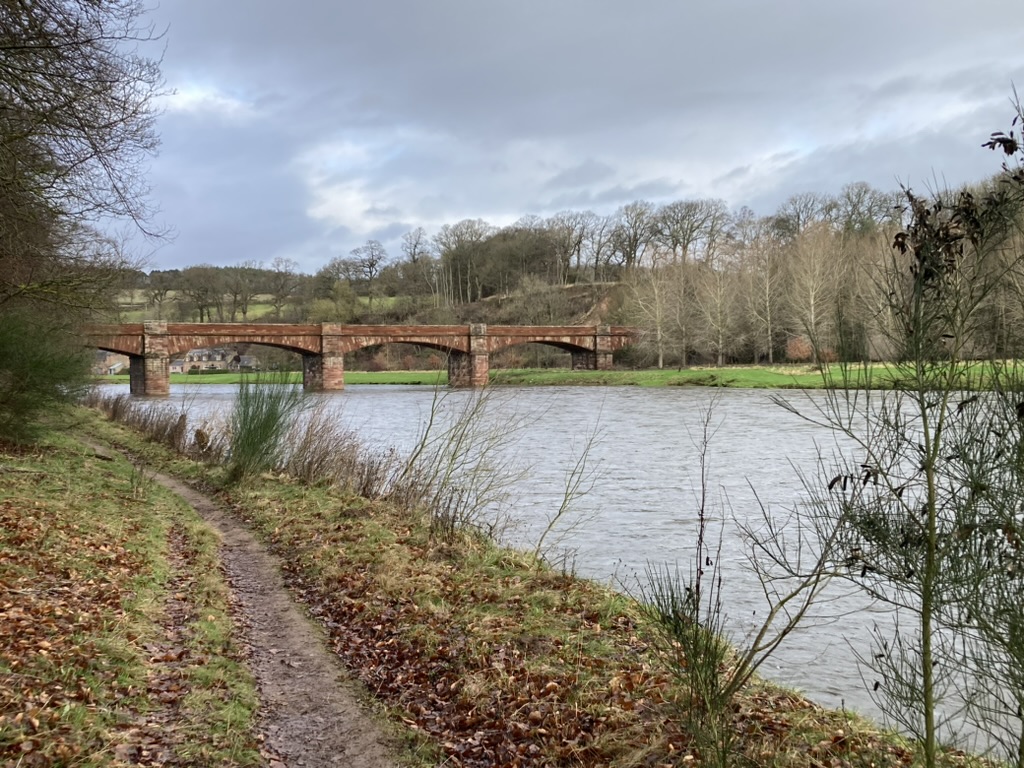
I decide that I’m going along as far as the Mertoun Bridge which is about a mile or so and then, if I feel like it, I’ll cross over the bridge and continue to walk along in the same direction looking for somewhere to stop for lunch.
After the meadow, there is a hill up through more woods and then I’m high above the river looking down through the trees on the sand martins and oyster catchers far below. In the field, right next to me as I stand and stare, a dunnock is having a bath in an old water-filled trough. I stay still until he’s finished but then he hops onto a nearby rock and starts drying and preening himself. Joe Harkness talks about dunnocks in his book, he says they are:
“the archetypal ‘little brown job’ which is a term that birdwatchers tend to assign to any small, nondescript and (obviously) brown bird. If you take your time and study one properly, you’ll actually see a deep palette of colours and markings taking shape. Delve further into their detail and you’ll begin to realise just how intricately marked they are.”
Personally, I feel I’ve noticed enough details for now, I’m getting hungry, so selfishly, before he’s halfway dry I decide to move on, finally startling him out of his own meditation and sending him fluttering to the nearest tree.
To get to the Mertoun Bridge I need to descend some roughly cut steep steps and as I approach them I know instinctively that this is danger time! If I’m going to fall….it’s going to be here. The top two steps are completely worn away meaning there’s a huge crumbly leap down to the first safe-looking standing place. Here’s where I turn back…..except without even a hesitation I hang on to a wooden post and lunge down, inelegant but achieved! I manage to come to a stop on the third step with only grumbling knees to show. Ha! Today is not a falling day! Down I go, one slippy slidey step after another until I’m on the road, a big silly smile on my face. Luckily there’s no-one to see and no traffic to bother me as I walk on across the bridge to the footpath on the other side.
The view from Mertoun Bridge…I’m heading for the path in the right hand corner.
More steps down on this side, but safer ones, built out of wood. And then I’m in the woods again walking along beside the river keeping an eye open for a good lunch spot. The path diverts away from the water for a while as the river bank is eroding but its soon back alongside and in the distance I can see a pebbly shore just right for a sit down.
I stay and eat. Across the water a pair of swans and oyster catchers, mallards and gulls. And in the air hundreds and hundreds of sand martins in their continual insect catching flight. I stay for an hour or so just watching.
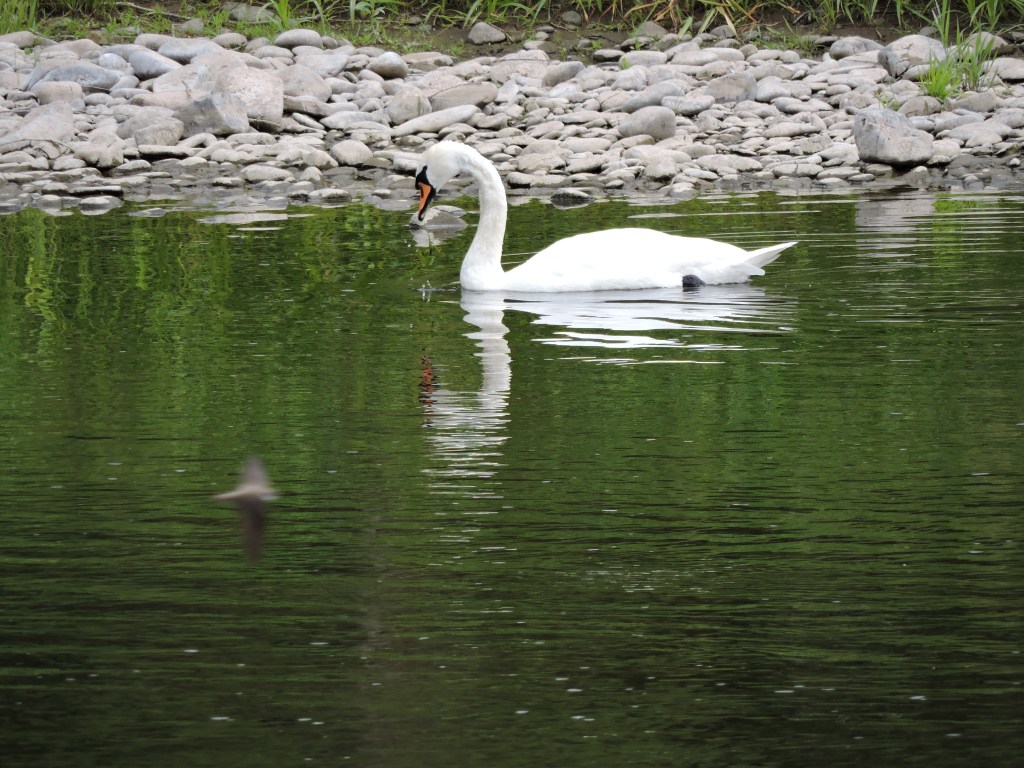
This swan floated along meditatively for the whole time I was there, oblivious to its surroundings, to the frantic flights of the sand martins (that’s the blur in the foreground) and the high pitched call of the oyster catchers….just all in its own world.
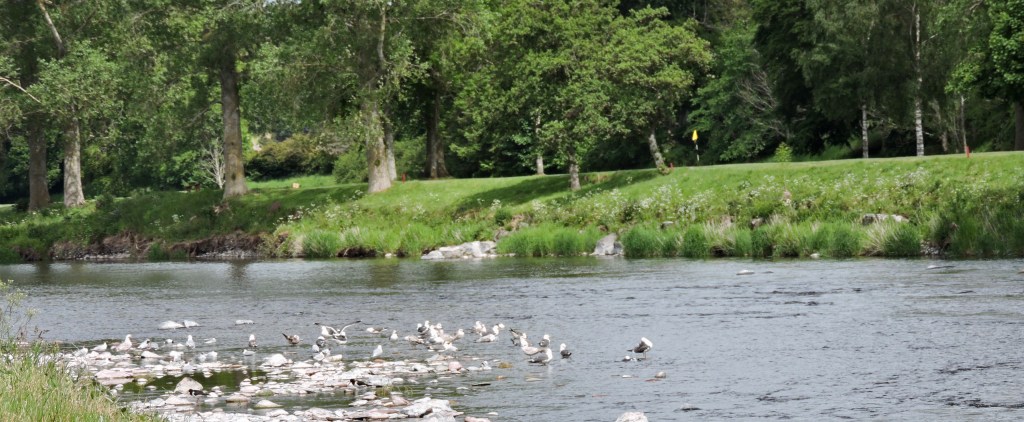
Decision time now….go back the way I’ve come or walk on the other bank of the river through the golf course and into St Boswell’s and back via the chain bridge. The golf course is busy and I’m reluctant to be ducking out of the way of golf balls and not feeling like nodding hello to golfers, so I go back the way I’ve come.
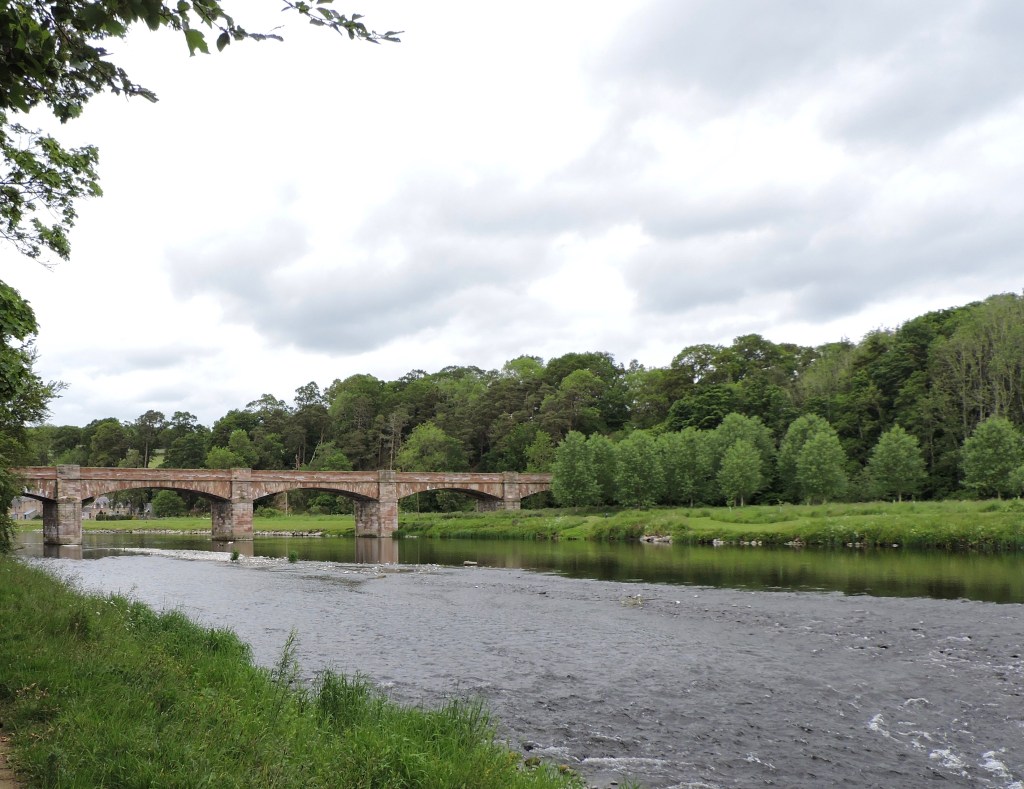
Mertoun Bridge on the way back.
Back up the wooden steps, knees creaking, across the bridge and make for the crumbly steps. I’ve deliberately not thought about getting back up till now, I have to do it so I just keep going. My feet slide under me a couple of times and then its a clamber up to the top over the missing step on hands and knees – even more inelegant! But I make it and set off across the field and back down through the woods, spotting a woodpecker on the way.
It’s a lovely afternoon so instead of heading back through the village, I find a place on the river bank and take out my book. It’s quiet, just the sound of the golfers shouting whatever it is they shout every now and then, and the oyster catchers calling their calls. And then about 20 minutes in…….a huge flock of gulls descend. Time to go!
The timing is right, I’m in need of a cup of tea and because the sun is shining families are coming to the river to paddle and play. I wander back slowly up the hill, past William Wallace and through the woods to the car, feeling quite pleased with myself…..I may do it again one day!
Bird Therapy is a lovely book by a guy who writes about his struggle with his own mental health and how connecting with nature and in particular with birds has helped him in his journey to wellbeing.
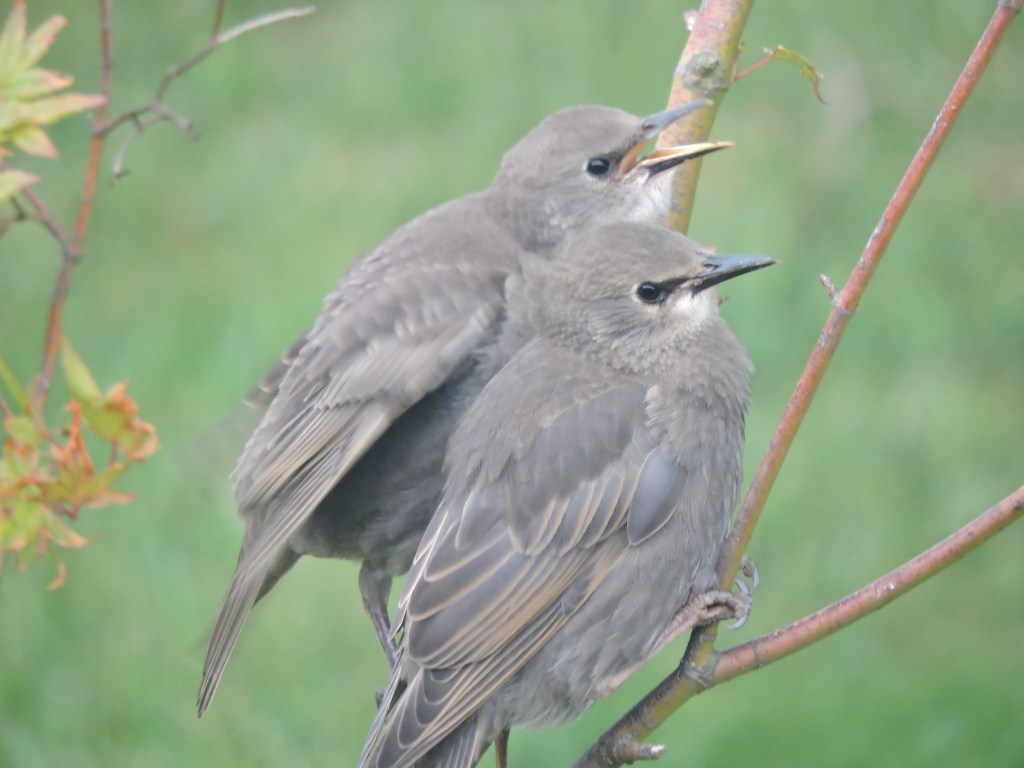
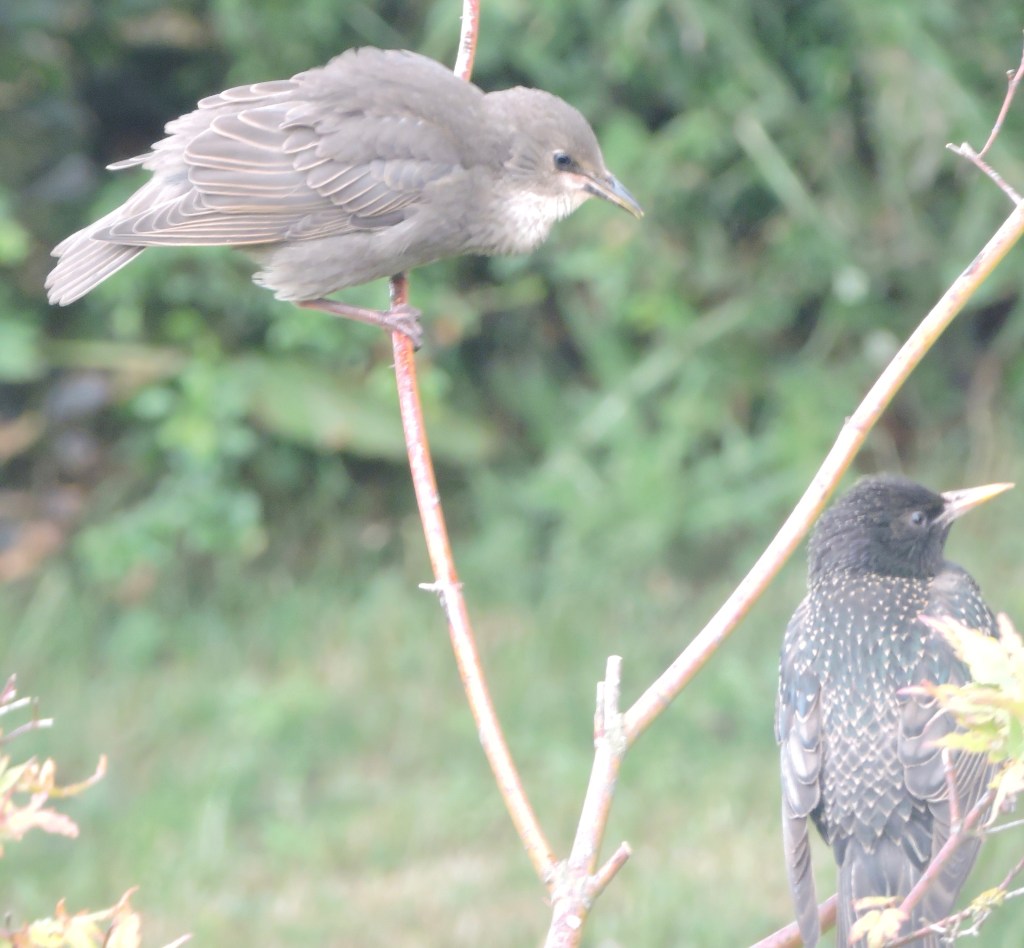
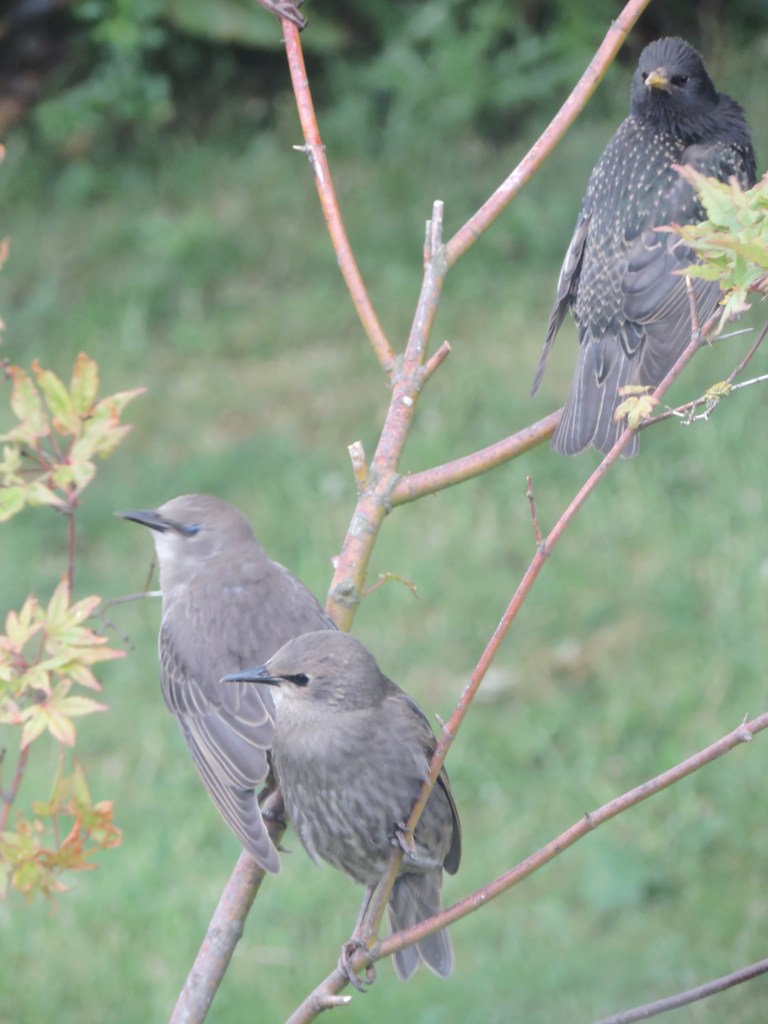
In the book Joe talks about a morning when he was ‘awoken at seven by a witch-like din of screeching and cackling from the back garden’. What he finds are ‘eleven shimmering starlings writhing across my feeders, jostling and snapping at each other….’ Well I know just what he means. We have our own ‘murmuration of starlings’ in our back and front gardens. Even as I write this, there must be 50 or so adult and juvenile starlings all trying to crowd onto the single bird feeder in the back garden and a similar cacophony happening in the front! All of the babies are fledged, and all of them are shrieking and screaming and demanding to be fed! Even the cat has retreated indoors and is sulking on the sofa!
I’ve decided this one is ‘walk of the month’ for January. We walked it yesterday, having been confined to the house by the truly miserable January weather for a few days. We convinced ourselves that once we were out and about, all would be well – and it was. The sun came out followed by all manner of birds and beasts! I think there was more variety of wildlife on this walk than we’ve ever seen before in one walk!
This ramble was more than week or so ago…..just playing catch up!
Ms L. has been walking the Southern Upland Way and camping along the route before coming to visit. We weren’t so adventurous but took a walk with her from the pretty village of St Boswells. The river was high following heavy rain the day before and the trees were beginning to change colour which is good, because Autumn is the most colourful season in The Borders. Continue reading →
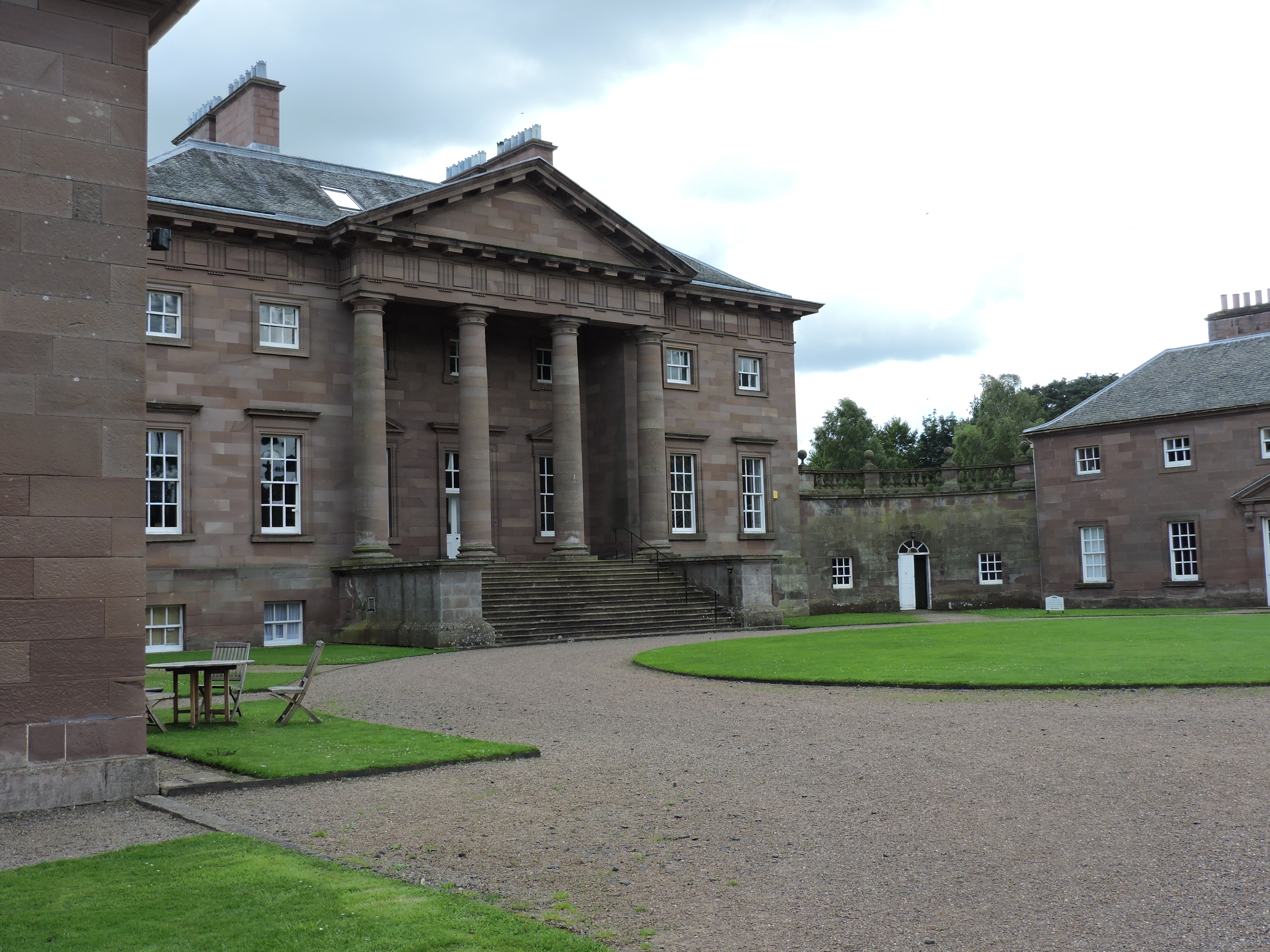
Mr RR and I visited Paxton House last Sunday – an 18th century mansion on the River Tweed. We didn’t go into the house this time, but had lunch in The Stables Tea Room and then wandered about the grounds before taking a short ramble along the river.
Here are some highlights!
Enjoy!
RR x
Paxton House to Chain Bridge Honey Farm via The Union Chain Bridge (and back again) – about 3 miles.
Paxton House built between 1758 – 1763.
The house was designed by John Adam, a Scottish architect (1721 – 1792), for Patrick Home, a rich young man who considered his family home near Eyemouth on the north-east coast too cold and draughty for a man of his means.
The herbaceous borders were looking splendid:
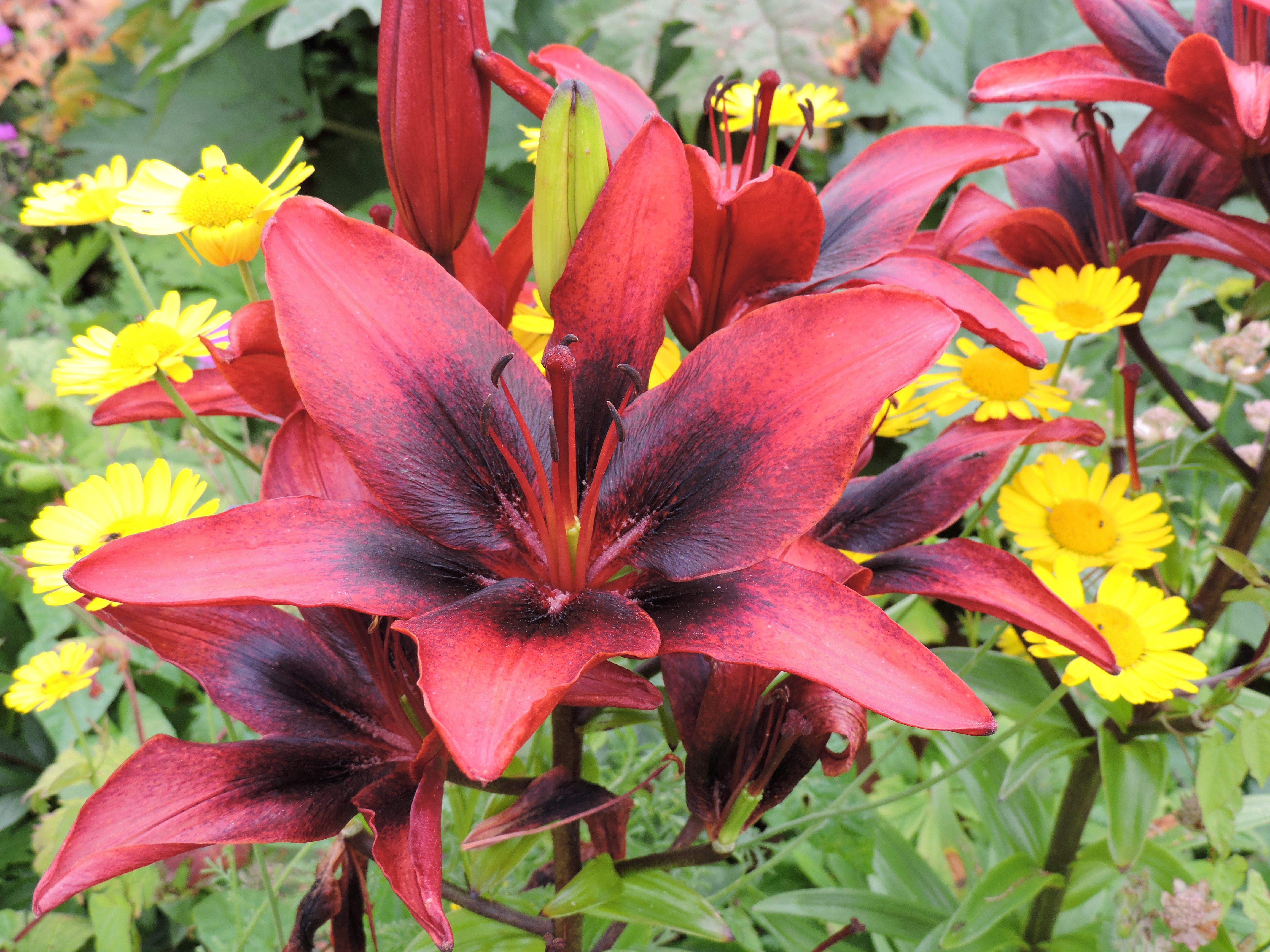
My favourite flower was this beautiful day lily:
Lots of bumblebees were enjoying the flowers too:
I’ve tried to identify this one but sadly the pictures aren’t good enough. the Bumblebee Conservation Trust – http://www.bumblebeeconservaton.org – has clear pictures for identification but there are so many different species – even lots of different ones with white tails like these, that it’s impossible to say.
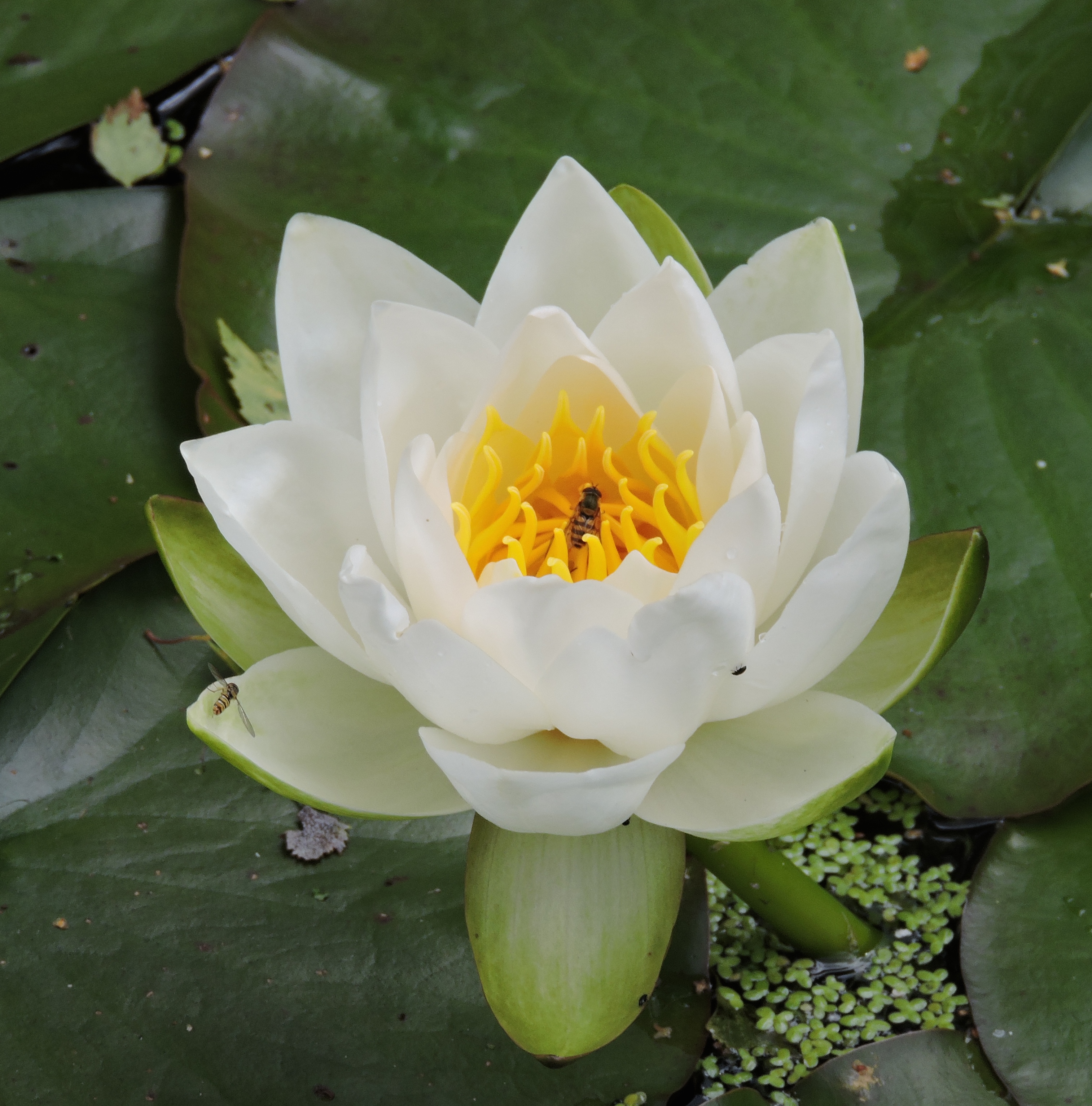
We walked on beside the croquet lawn and putting green to a small pond filled with waterlilies:
and then down over the hill through the woods to the River Tweed.
The path took us along to a bird hide where we stopped to see what we could spot. An information board tells us that, because we’re not far from the sea here, the river is tidal and the mixture of fresh and salt-water means that often sea birds are seen and even seals on occasion. We see some ducks which are too far away to identify but otherwise nothing of interest, so we follow the path on through the woods and over a stile until we’re right next to the river.
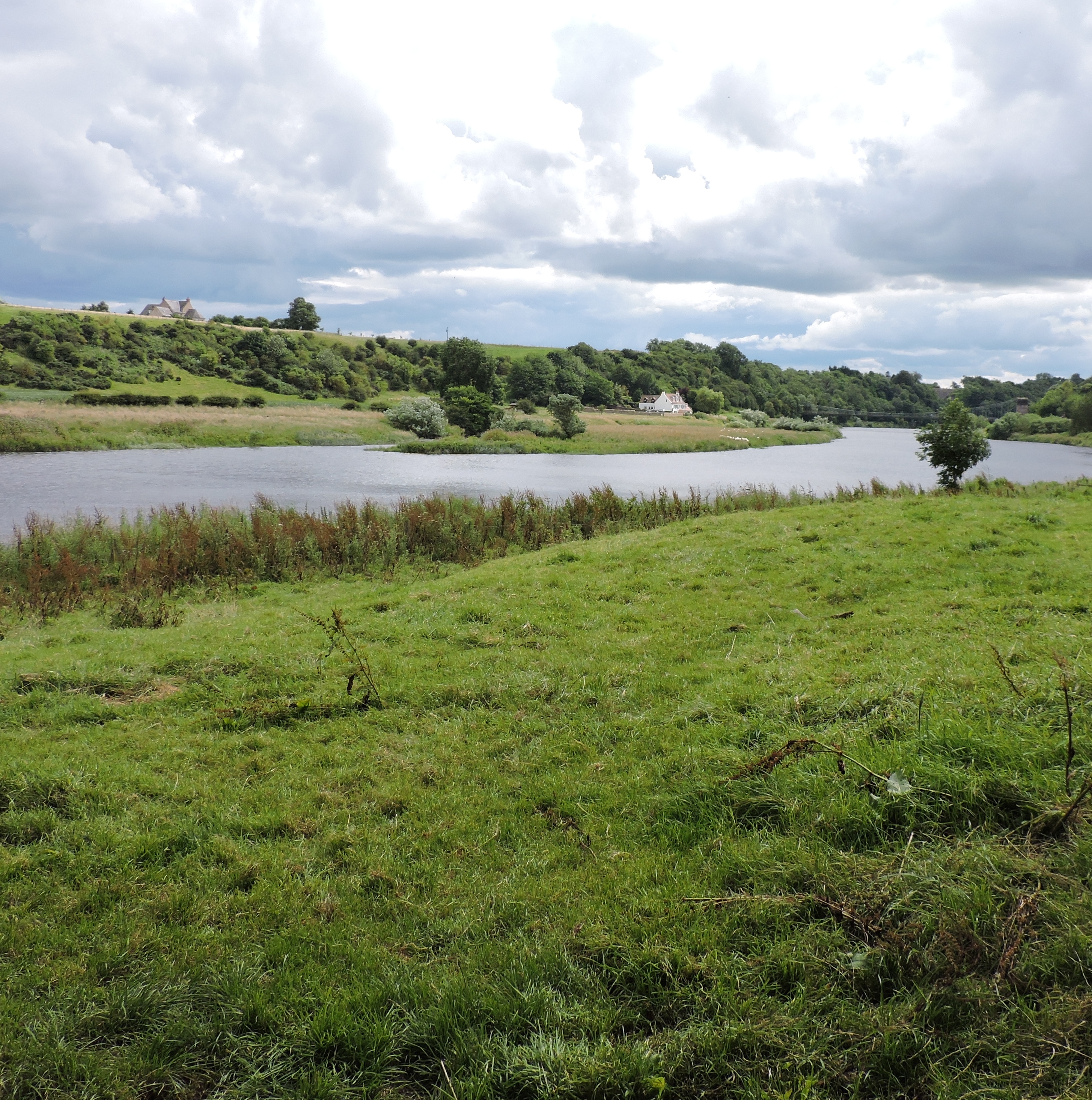
Right in the middle of the River Tweed at this point is the border between Scotland and England – so…..we’re in Scotland as we ramble along….but those sheep in the picture above are in England; they are obviously keen to cross over though as they keep edging towards the water and staring longingly across at us! Clever sheep!
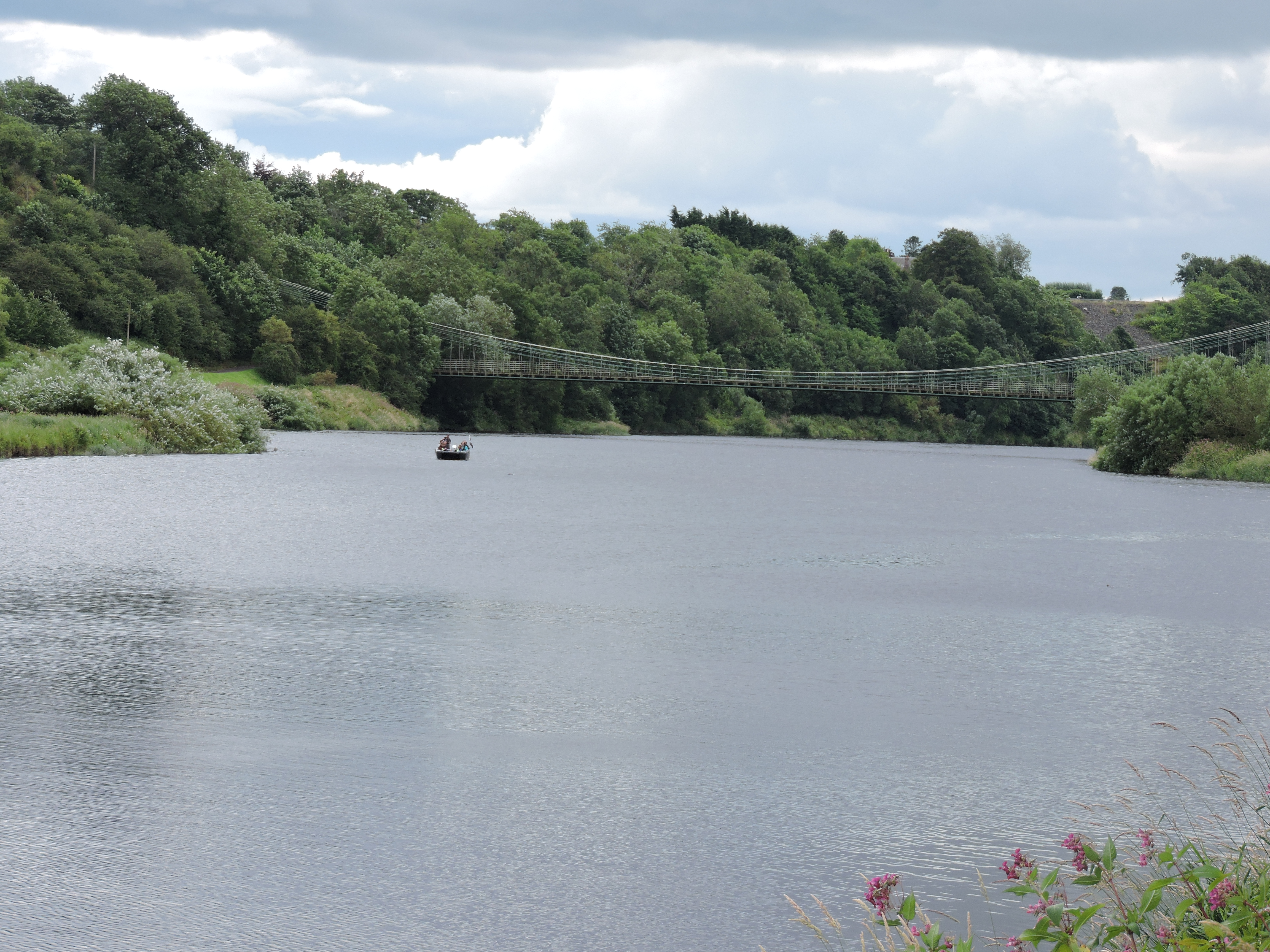
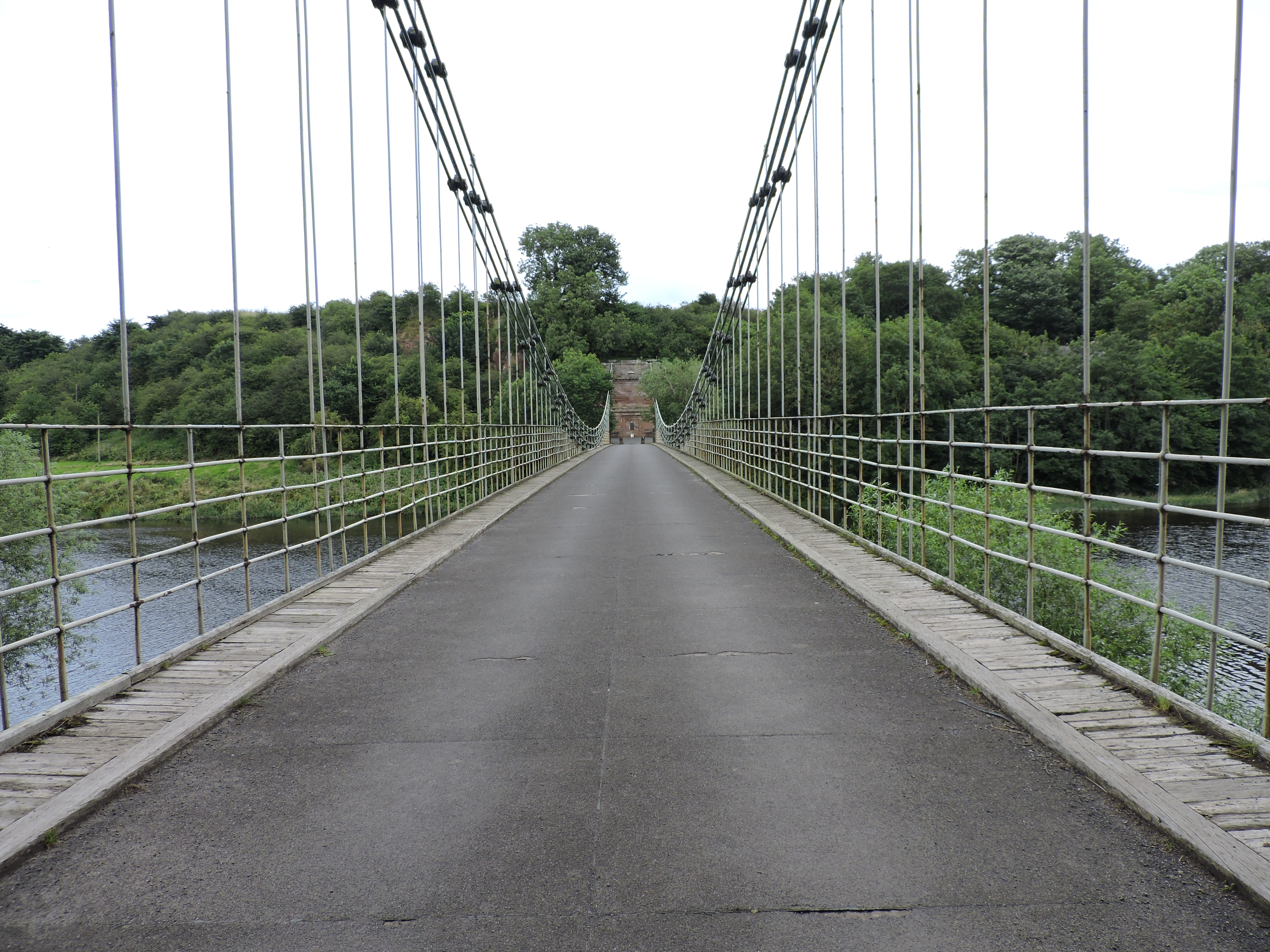
About half a mile downstream we can see the Union Chain Bridge in the distance:
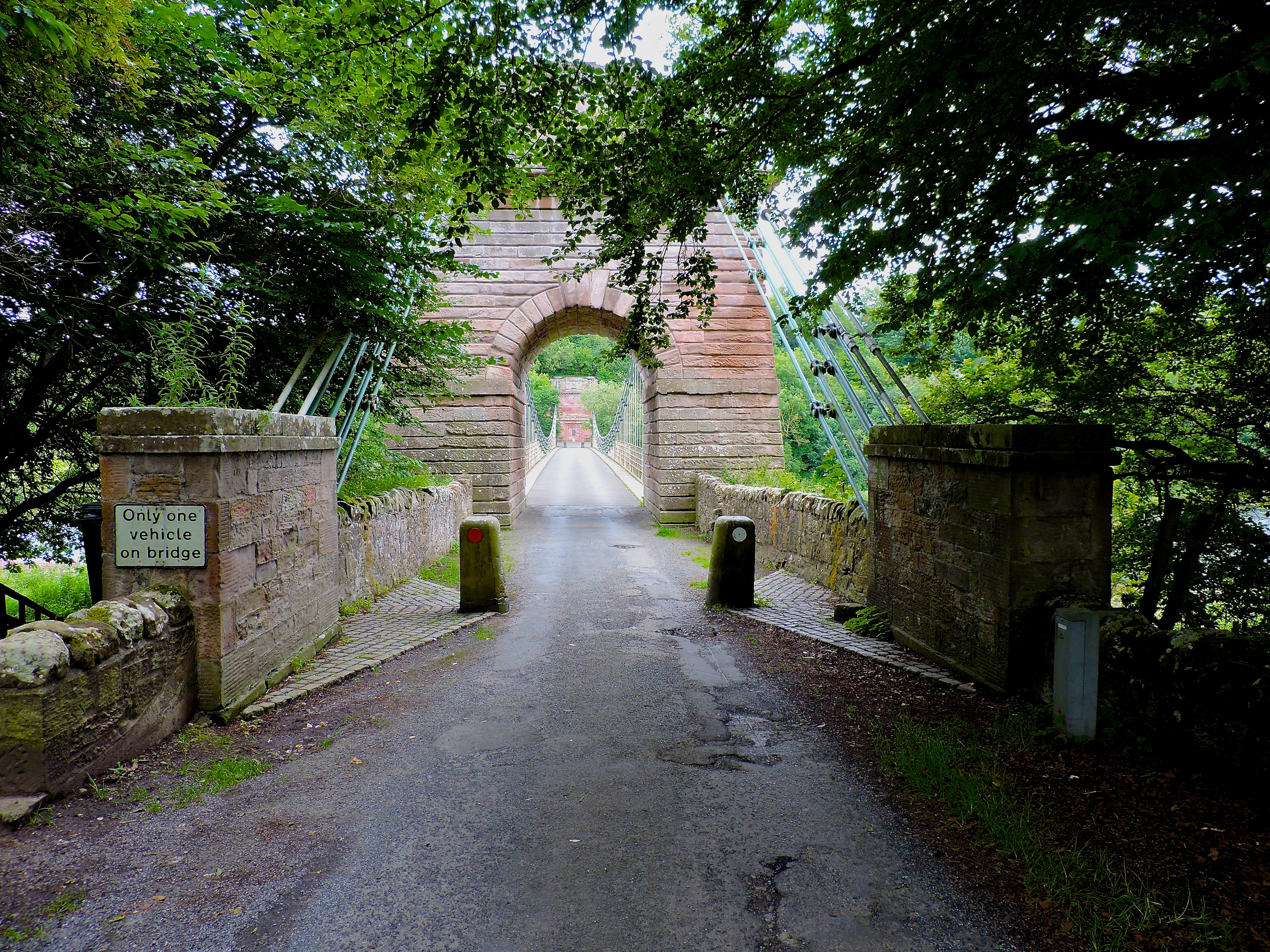
This is the oldest surviving iron suspension bridge in Europe! It was the very first one to be designed to take vehicles although now it’s not strong enough to take more than one car at a time:
By the late 19th century it was becoming imperative to have a safe crossing to take coal and lime from Northumberland to Berwickshire for export. Before the bridge was built the only way to cross the Tweed between England and Scotland at this point was at the New Water Ford which could be perilous in flood water and dangerous even at high tide. So along comes Captain Samuel Brown RN who, whilst still in the navy, had pioneered the design. It took less than a year to build and was opened on 26th July 1820 with a demonstration of its strength by Captain Brown who drove across in a curricle followed by 12 loaded carts weighing 20 tons, and 600 spectators! The event was witnessed, not only by the Scottish engineer Robert Stevenson, but also by the 18 year old Isambard Kingdom Brunel who, of course, went on to build the infamous Clifton Suspension Bridge across the Avon Gorge in Bristol.
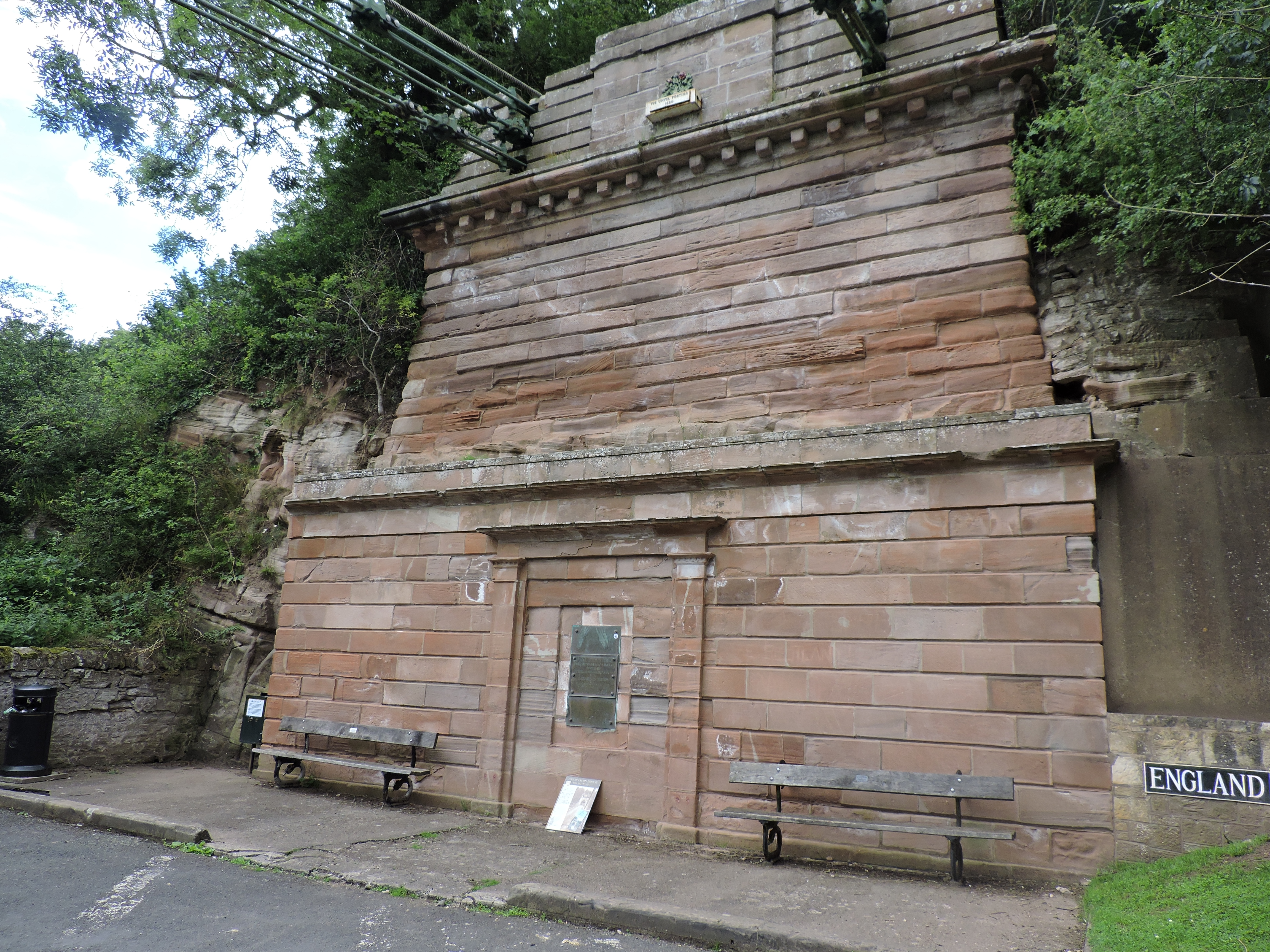
At the far end you can see what remains of the Toll Keeper’s Cottage built into the red sandstone cliffs on the English side. The actual cottage was demolished in 1955 but in the early 1900s a family of five lived in its two rooms.
The site of the Roxburgh family home
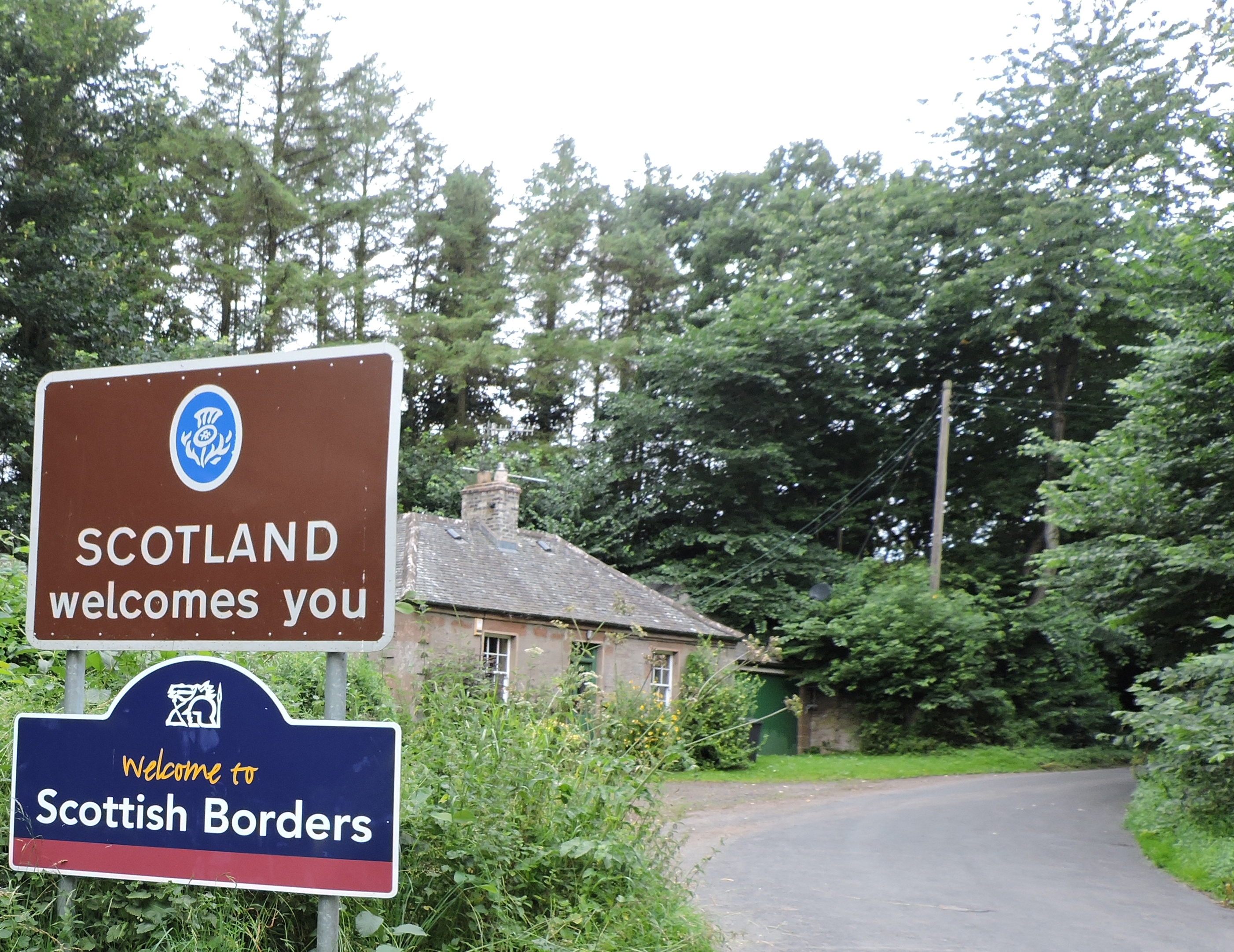
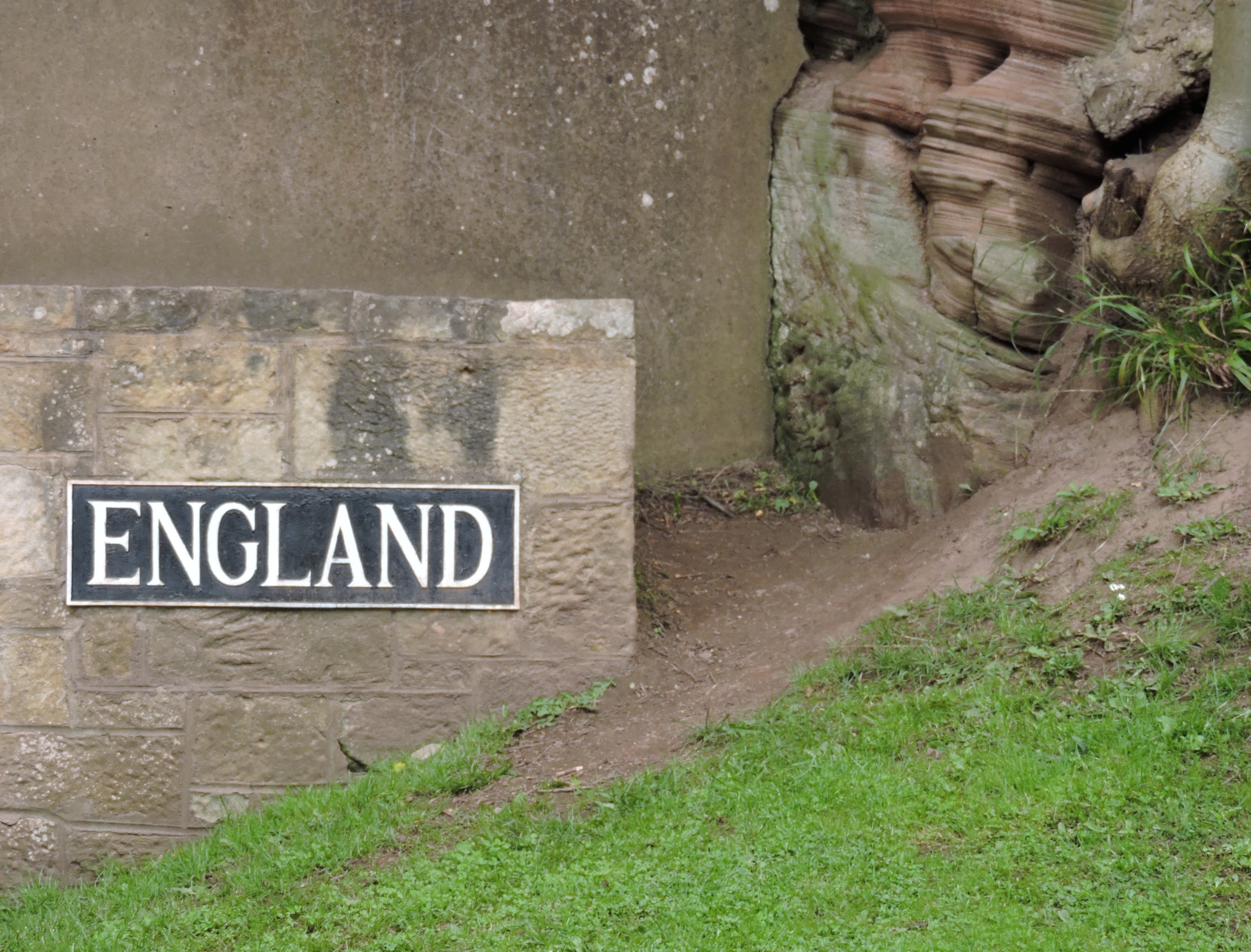
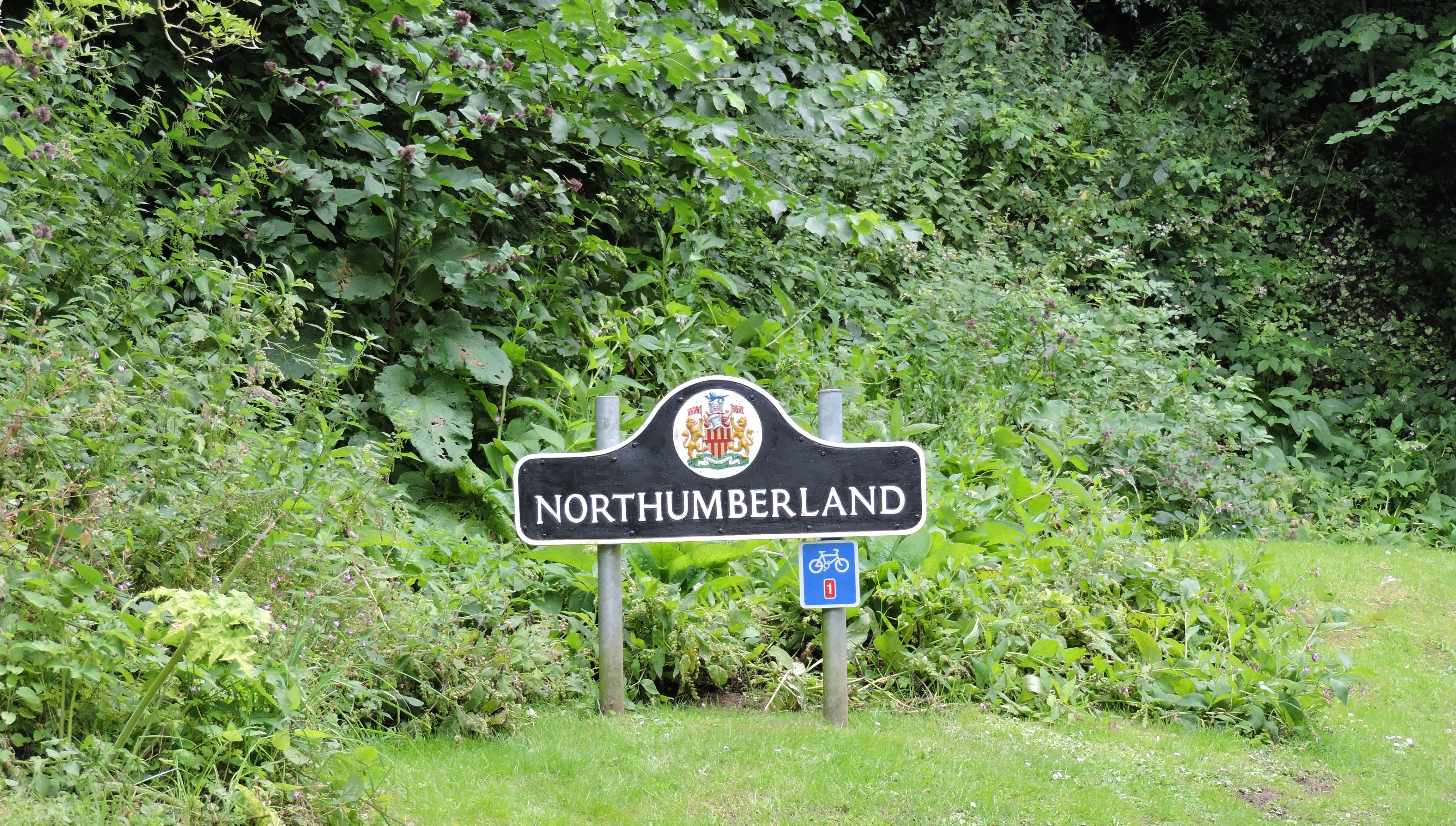
We reach the crossing point and spend some time looking over the border and watching some German motorcyclists taking pictures of themselves beside the border signs. I decide I should do that too…..although Mr RR politely declines to have his picture taken in either Scotland or England!
Here we are in Scotland……
And now here we are in England…..
Northumberland to be exact!
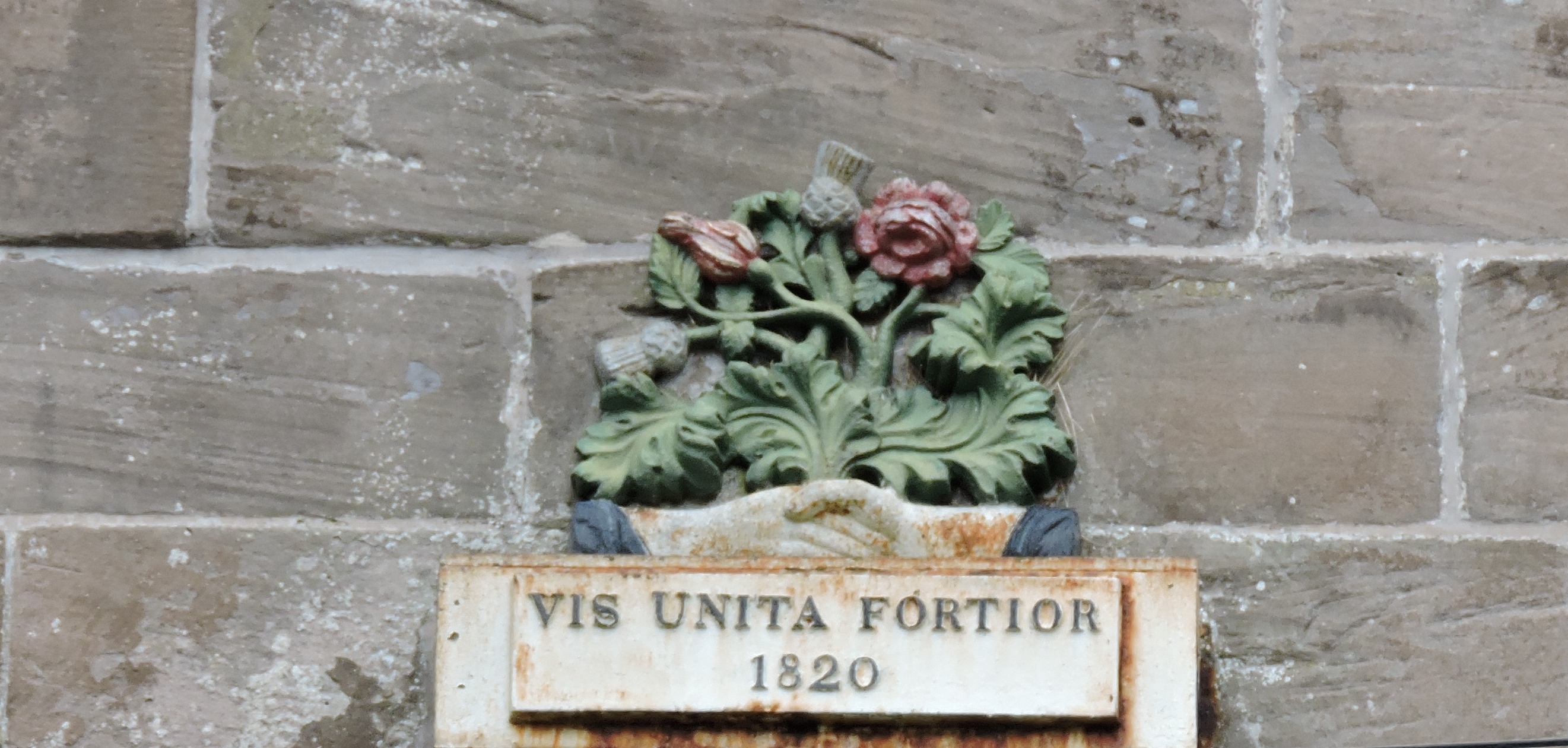
High above us, on both bridge towers is a a plaque in the form of an intertwined rose and thistle bearing the legend:
Vis Unita Fortior………United Strength is Stronger. Very apt in 2016 don’t you think? Or maybe not….. depending on your point of view!
On the English side there is information relating to the fact that this icon of British civil engineering is nearly 200 years old now and much loved by local communities on both sides of the border. Fundraising is underway to complete a major programme of restoration by 2020. There’s a little honesty box for some donations which we add to, helping ourselves to an information leaflet which tells us that just 200 metres uphill from the bridge on the English side is the Chain Bridge Honey Farm with Honey Museum Visitor Centre and a tea shop in a double decker bus! Well…..how lucky is that!
Off we trot up the hill. Chain Bridge Honey Farm ( http://www.chainbridgehoney.com ) was started by beekeeping advisor William Selby Robson in 1948 and subsequently expanded into a successful commercial enterprise by his son Willie on Williams’ death in 1962. The bees came from local retiring bee keepers and were kept in hives made from a local timber known as Thuja – which is very light and resistant to decay. There are now nearly 2000 hives on the farm……although we couldn’t see a single one, even from the upper deck of the double decker bus!
The Honey Farm has the most amazing little museum and visitor centre, absolutely full of intricately researched information all about bees and honey and bee hives as well as a whole room devoted to information about the building of suspension bridges. Much of it is hand-written and illustrated and all of it is fascinating. I was a bit slow though – I was so looking forward to tea on a double decker bus that I didn’t even think about looking up those bees we saw earlier. We bought some honey (well you have to really don’t you) and wandered off to find the bus.
Will you just look at that! This bus originally ran on the Bristol to Bath route and the upstairs is beautifully converted. We had a lovely tea of scones and jam and honey cake.
All too soon we have to leave the farm, head back downhill and recross the border into Bonnie Scotland. We make our way back along the footpath towards Paxton House, passing our original trail uphill and carrying on along the river a little way before turning left and up a steep hill, through the woods, back to the house.
The walk to Mrs Buller’s Seat which is in the Cicerone Walker’s Guide to The Border Country begins with the following phrase: “A wistful linear stroll from Sir Walter Scott’s favoured viewpoint……”. Now, if this is ringing bells with you – you get top marks, because we started this walk once before (read about it here: In Scott’s Footsteps ) and cut it short exactly because, along the way, we discovered it was ‘linear’! So what happened this time? Continue reading →
It’s been a while I know, but here’s another ramble…..I promise to try and pick up the pace a bit and walk more!! That’s enough about that!
This morning we followed a walk from a little book called ‘The Scottish Borders – 40 favourite walks’ by Robbie Porteous. Part of it we’ve done before and you can read about it here: The Hirsel Country Park. This walk begins in the town of Coldstream and wends its way along the banks of the River Tweed and through Dundock Woods before reaching The Hirsel. Continue reading →
Mr RR and I found ourselves with an unexpectedly free day so decided to take stroll in the footsteps of Sir Walter Scott who loved this area so much that he managed to get a viewpoint named after himself! Continue reading →





















 ricketyrambler